 AIAI in Web Development: What Works in 2026How AI in web development really works in 2026: coding tools, AI features for users, prompt-to-app builders, survey data, and the risks to plan for.
How Dubai Police Uses AI to Improve Public Services
How Dubai Police uses AI for minor accident reports, vehicle history checks and the Amna virtual officer, and what UAE businesses can learn from it.
Dubai Police uses artificial intelligence to cut paperwork, answer the public faster and make records harder to tamper with. Its best known projects include AI generated reports for minor traffic accidents, a vehicle accident history service for used car buyers, a virtual officer called Amna inside the Dubai Police app, and a blockchain platform for lost passport certificates. Together they show how a government body can use AI to remove steps from everyday services rather than simply add technology for its own sake.
This article looks at each service, what it changes for residents and what other organisations in the UAE can learn when they plan their own AI and app projects. Figures quoted below come from the Dubai Government Media Office (June 2024) unless stated otherwise.
Why Dubai Police is investing in AI
The UAE has made digital government a long running priority, and Dubai Police has been one of the most visible adopters. The logic is practical. A police force handles a huge volume of routine requests: accident reports, certificates, enquiries and record checks. Every one of those that can be completed accurately without a visit to a station saves time for residents and frees officers for work that needs a person.
The Dubai Government Media Office reported in June 2024 that Dubai Police had integrated AI systems into 29 administrative operations across its departments. AI is not confined to one flagship app; it is spread across the back office as well as the services the public sees.
How Dubai Police uses AI and related technology
AI reports for minor traffic accidents
Minor accidents with no injuries are among the most common incidents any traffic police force deals with. Dubai Police uses AI to analyse the details of a minor accident and produce the report without human intervention. According to the Media Office, this reduced the steps needed to obtain a minor accident report from seven to four.
For drivers, fewer steps mean less time at the roadside and a quicker route to insurance and repairs. For the police, automated reporting means officers are not tied up on low risk incidents. It also produces more consistent reports, because the same rules are applied every time.
Vehicle accident history for used car buyers
Dubai Police has also used AI to let prospective buyers check a vehicle's accident history. Anyone who has bought a used car knows the risk of hidden damage. Giving buyers access to recorded accident history makes the second hand market more transparent and helps them judge whether a car is worth the asking price or needs a closer inspection.
The wider point is about data that already exists. Accident records were always held by the police; the change is making them useful to the public in a controlled way, at the moment of a buying decision.
Amna, the virtual police officer
Amna is an AI powered virtual officer available in the Dubai Police app. She answers questions about police services in Arabic and English and responds to voice commands, so residents can get help without searching menus or waiting for a call centre. The Media Office reported that Amna held 20,000 conversations with the public in 2023.
The Dubai Police smart app itself is available on iOS, Android and Huawei devices. In June 2024 the Media Office reported around 7.9 million downloads, 70 services and support for seven languages. Putting a conversational assistant inside an app with that reach means many routine questions can be answered at any hour.
Blockchain for lost passport certificates
Not every project is AI. When someone loses a passport in Dubai, they need a police certificate before a replacement can be issued. Dubai Police moved this service onto a secure blockchain platform shared with other government bodies, so records cannot be quietly altered and applicants no longer need to visit service centres. The Media Office reported that 66,413 certificates were issued through the service between 2021 and June 2024.
Blockchain suits this use because several authorities need to trust the same record. Each one can verify a certificate without relying on paper copies or phone calls between departments.
What these services have in common
| Service | Technology | What it removes |
|---|---|---|
| Minor accident reports | AI analysis of accident details | Waiting for an officer and several manual steps |
| Vehicle accident history | AI on existing police records | Guesswork when buying a used car |
| Amna virtual officer | Conversational AI with voice | Searching menus or calling for routine answers |
| Lost passport certificates | Shared blockchain record | Station visits and paper verification between authorities |
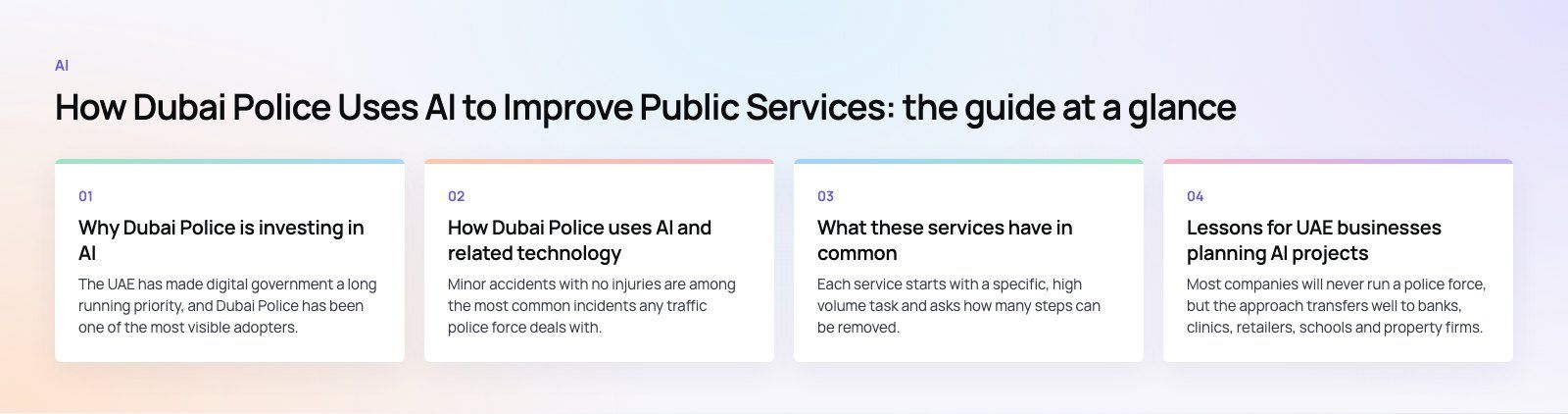
Each service starts with a specific, high volume task and asks how many steps can be removed. None of them tries to replace the police force with technology. They take the routine work off the queue so that people handle the cases that need judgement.
Lessons for UAE businesses planning AI projects
Most companies will never run a police force, but the approach transfers well to banks, clinics, retailers, schools and property firms.
Start with a high volume, low risk process
Minor accidents were a sensible first target because they are frequent and the rules are clear. In a business, the equivalent might be order status questions, appointment changes, document requests or lead qualification. Pick something people do hundreds of times a week where mistakes are easy to spot and fix.
Measure the steps, not just the technology
The most useful figure in the Dubai Police story is not a download count; it is seven steps becoming four. Before building anything, map the current process and count the steps, handoffs and waiting time. That gives you a baseline and a clear way to show whether the project worked.
Put the service where users already are
Amna lives inside an app residents already use. A new AI assistant hidden on a separate website would get far less use. For most businesses that means adding features to an existing app, website or WhatsApp channel rather than launching something new. Our mobile app development team often starts by reviewing what the current app already does well.
Support Arabic and English from day one
Amna answers in both languages, and the Dubai Police app supports seven. In the UAE, bilingual support is not an extra; it decides whether a large share of customers can use the service at all. Right to left layouts, Arabic search and Arabic voice input need planning at the design stage, as we did on the bilingual Diyafah school website.
Use shared records where several parties need trust
The passport certificate service works because several authorities read the same tamper resistant record. Businesses with partners, such as insurers and garages, landlords and agents, or suppliers and retailers, can use integrated systems or shared ledgers to stop the endless exchange of PDFs and emails. Often a well designed integration is enough; blockchain is only worth the complexity when no single party should control the record.
Keep a person in the loop for exceptions
Automation handles the simple cases. Disputes, injuries and unusual situations still need a human. Design every AI service with a clear route to a person and make sure that route is easy to find.
Data protection and trust
Public services built on personal data only work if people trust them. Any UAE organisation planning an AI service should check its obligations under UAE data protection law, and any free zone rules that apply, before collecting or processing personal information. Be clear with users about what the AI does, what data it uses and how they can reach a person. Trust lost through a careless data practice is very hard to win back.
What comes next
Dubai Police continues to expand its use of AI across operations, and other UAE government bodies are moving in the same direction. For businesses, the expectation this creates matters most: residents who can get a police report in a few steps will expect the same from their bank, their clinic and their online shop.
Codeeo has delivered 200+ projects across the UAE and the US with a team of 80+ across Dubai, Riyadh and Karachi. If you are planning an AI feature, an app or a custom software system that takes steps out of a busy process, talk to our team.
Frequently asked questions
Dubai Police uses AI to generate minor traffic accident reports without human intervention, to give used car buyers access to a vehicle's accident history, and to power Amna, a virtual officer in its app that answers questions in Arabic and English. The Dubai Government Media Office also reported in June 2024 that AI had been integrated into 29 administrative operations.
AIAI in Web Development: What Works in 2026How AI in web development really works in 2026: coding tools, AI features for users, prompt-to-app builders, survey data, and the risks to plan for. AIAI Automation for Accounting Firms in the UAE: 7 WorkflowsSeven workflows a UAE accounting firm can automate before the 2027 e-invoicing deadlines, the FTA rules each one must respect, and the decisions that must stay with a qualified reviewer.
 AIHow Well Do AI Models Handle ArabicArabic AI models are strong on Modern Standard Arabic and weaker on Gulf dialect. What the benchmarks mean, why Arabic costs more tokens, and what to test before customers see it.
Tell us what the business needs. We will tell you what to build first.
Schedule a free consultation and get a written recommendation, with costs, before you commit to anything.
Get in touchPROVEN RESULTS
4.7 / 5verified reviews on Google