 Web DevelopmentTop WordPress Web Development Services to ConsiderThe WordPress web development services worth paying for: custom builds, design, themes, plugins, WooCommerce, speed, security, SEO and migration, and how to choose a team.
Best Website Designing Company in Dubai
How to choose a website designing company in Dubai: business goals, the right platform, SEO and conversion, costs and timelines, and support after launch.
The best website designing company in Dubai is the one that understands what your site has to do for the business, then designs, builds and looks after it with that goal in mind. A good-looking homepage is the easy part. The real test is whether the team can also handle structure, speed, search, integrations and the years of changes that follow launch. At Codeeo we design websites and build custom software and web apps, with more than 200 projects delivered across the UAE and the US, so this guide is written from the side of the table that does the work.
Summary
Pick a partner on fit, not on portfolio polish. Start with business goals, choose technology that suits the job, plan SEO and conversion before anything is built, and make sure someone will support the site once it is live. If you want a side by side look at other firms, we keep a separate comparison of ten Dubai agencies. This piece is about how to choose well and how we approach the work.
What a good web design partner in Dubai actually does
A serious partner asks what the site must achieve before anyone mentions colours, layouts or platforms. That means learning who your buyers are, what you sell, how enquiries reach your sales team, and whether the site also carries hiring, support or investor relations. Professional web design is a process that ties user experience, content, technical choices and analytics together. The visuals come out of that thinking, not ahead of it.
Dubai adds its own pressure. One site often has to work for local customers, regional decision makers, international buyers and people reading on a phone between meetings. A capable team handles that mix without cramming every message onto every page. The finished site should look credible, load quickly and make the next step obvious.
No single agency suits every company. A startup usually needs a focused marketing site and a clear launch plan. A larger business may need several languages, CRM connections, secure client areas or cloud infrastructure that can grow. The right partner shapes the project around your situation instead of pushing everyone through the same template.
Start with business clarity, not wireframes
Before a single screen is drawn, a few questions need honest answers. Who is the site for? What decision do you want the visitor to make? What do they need to know before they trust you? And which action matters most: booking a call, requesting a quote, buying a product, downloading a document or opening an account?
This is where good website development in Dubai separates itself from the rest. Once the strategy is settled, design decisions get much easier. Navigation can lead with the pages that earn money, calls to action can follow the buyer's journey, and copy can answer real objections rather than repeat sales lines.
In our discovery sessions we usually look at five things:
- Who visits: local customers, regional buyers, partners, investors, job seekers or returning clients.
- What the business needs: leads, online sales, internal efficiency, a repositioned brand or customer self service.
- What gets in the way today: slow pages, muddled messaging, a weak mobile experience, poor SEO structure, old technology or content that is painful to update.
- What the build has to connect to: payment gateways, booking systems, dashboards, user roles, APIs, cloud hosting or back office tools.
- How success will be measured: qualified enquiries, sales, fewer support calls, better engagement or simpler internal management.
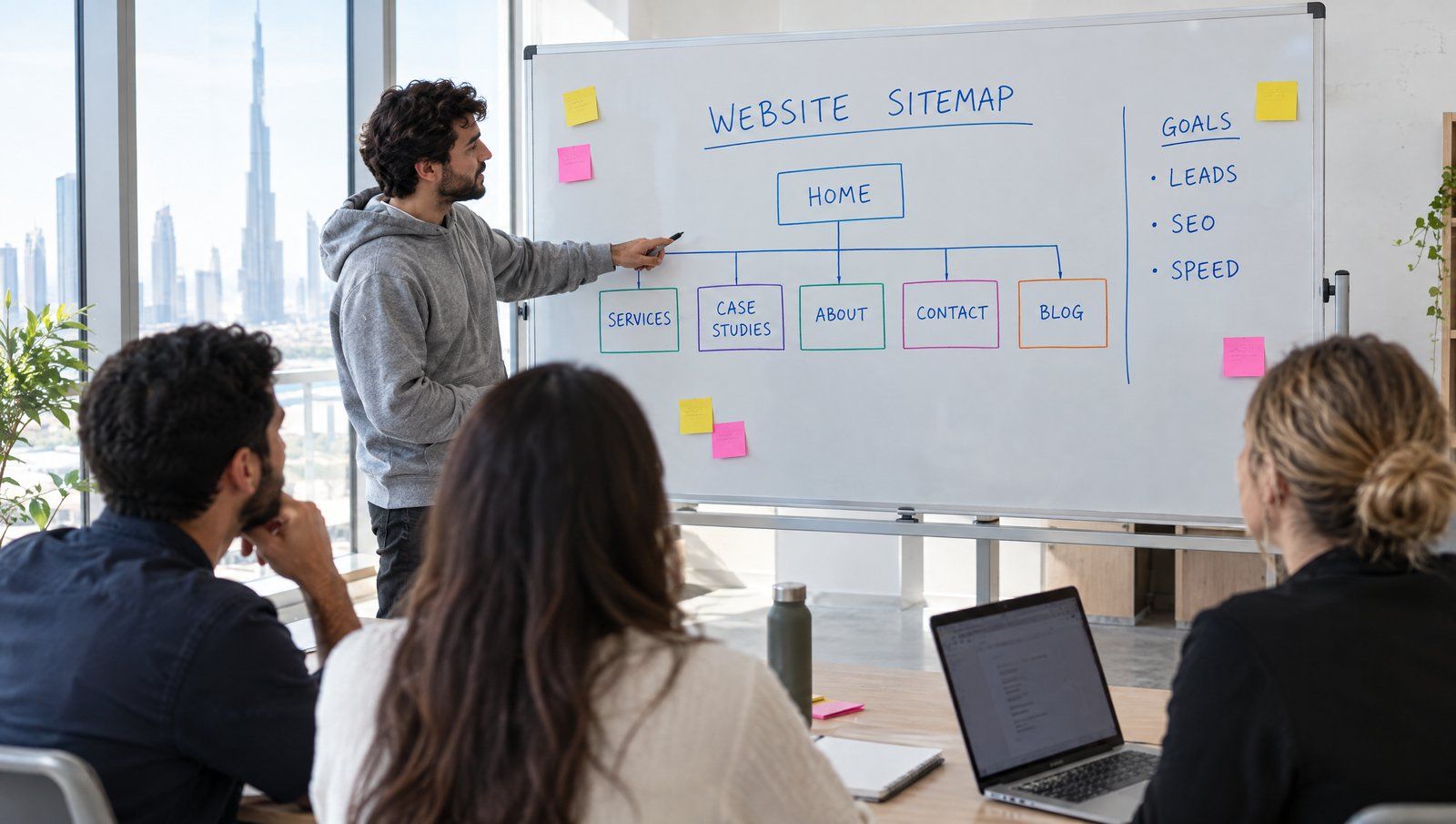
Discovery is also the moment for an agency to tell you what you do not need. Plenty of companies are better served by a well planned WordPress build or a Shopify store than by a custom platform on day one. Sometimes the smartest plan is phased, starting with the pages that will make the biggest difference.
When custom design is worth it
Templates are fine for small, simple launches. They start to hurt when a company needs to stand apart, move fast or do more than display information. A template can look tidy at first and still make your brand feel interchangeable, because the layout and user journey were never shaped for your market. In sectors such as real estate, healthcare, logistics, professional services and retail, that lack of fit costs trust.
Custom professional web design gives you control over how people move through the site. You can put the proof buyers care about where they will see it, explain complicated services simply, support Arabic and English properly, and build separate paths for different kinds of visitor. It also brings the site in line with the reputation you have already earned offline.
Creative web solutions are not about extra animation. They are about solving a communication or usability problem in a way that feels like your company. A property developer may need search and lead routing. A clinic may need service pages that feel calm and easy to read. A logistics firm may need tracking and quote requests linked to its internal systems. A retailer may need filtering, several payment options and landing pages for each campaign.
An experienced team knows when a familiar pattern is the right answer and when something bespoke is needed. Visitors should not have to learn a new way of using the web to find out what you do. They should see quickly why you are relevant, credible and easy to deal with.
How to find the best website designing company in Dubai for your stage
Choose the agency that matches where your business is now and where it is heading, rather than the one with the most impressive showreel. Young companies tend to need speed, flexible scope and help getting to launch. Established companies usually need deeper architecture, documentation, security thinking, integrations and dependable support. The right fit is the team that can carry you through your next stage, not only the current brief.
This table is a quick way to match priorities to your situation:
| Your situation | What to prioritise | Why it matters |
|---|---|---|
| Startup or new brand | Tight scope, clear messaging, quick launch, a foundation that can grow | You need momentum without building too much too early. |
| Growing service business | SEO-ready structure, lead capture, CRM or form workflows, sound UX | The site has to turn visitors into qualified conversations. |
| Online retailer | Product structure, checkout, payments, analytics, speed | Small usability problems cost sales and repeat orders. |
| Enterprise or multi-location company | Custom development, integrations, governance, security, cloud readiness | The site often has to connect to existing systems and serve many teams. |
| Software or platform company | Product thinking, dashboards, user roles, APIs, DevOps, regular releases | The website is often one part of a wider product. |
When you review an agency, look past the screenshots. Ask how they run discovery, map user journeys, handle revisions and support content updates after launch. A beautiful site your team cannot maintain becomes a burden very quickly.
Ask, too, who will actually do the work. A slick sales process tells you little about the delivery team. Good agencies are open about project management, design reviews, development milestones, testing, deployment and support, and they will introduce you to the people involved.
Let the job decide the technology
There is no perfect stack for every website. The right choice depends on your content, integrations, growth plans, in-house skills, security requirements and budget. A good agency explains the trade-offs in plain language rather than recommending the same platform to every client.
For content-led sites, WordPress is often sensible because your team can publish pages, articles and landing pages without a developer. Shopify suits many retailers that want a managed commerce platform, while more unusual stores may need custom work. Web apps and complex front ends may call for React or Angular, back ends for Node.js or Laravel, and hosting for AWS or Azure.
Trendy tools are not the point. What matters is technology that supports speed, security, easy maintenance and future change. If you expect user accounts, advanced search, bookings, quote systems, dashboards or integrations, those plans need to shape the architecture from the beginning.
This is where we tend to be most useful: projects that grow beyond a brochure site into custom software, web apps or continuing product work. If your product runs in containers on Kubernetes or OpenShift, our team can help plan the architecture, and our guide to OpenShift vs Kubernetes sets out how to choose between them.
Plan for search and conversion at the same time
SEO is not something you bolt on after launch. If search traffic matters, the site structure, page hierarchy, internal links, metadata, content model and speed all need planning early. A site can look excellent and still struggle if search engines cannot read it or visitors cannot find what they came for.
For Dubai businesses, local relevance matters as well. Service pages should say plainly what you offer. Location pages should be genuinely useful rather than lists of place names. Phrases such as web design in Dubai or Dubai web design belong in the copy only where they help a reader understand the service. Our local SEO team plans this structure alongside the build rather than after it.
Conversion is the other half. Once someone lands on a page, the next step should be obvious. That might be a persistent enquiry button, a short quote form, clearer service options, stronger proof, comparison content or a booking flow with fewer distractions.
Our working checklist for search and conversion covers:
- One job per page: each important page answers one buyer question or supports one action.
- A fast mobile experience: phone users can read, compare and get in touch without friction, which is what our Core Web Vitals service focuses on.
- Navigation that matches how customers think: not how your org chart is arranged.
- Readable, search-friendly content: clear headings, URLs, metadata and body copy written for people.
- Proof: case studies, client logos, reviews, certifications and team details that reduce doubt.
- Measurement: analytics and conversion tracking so you can see what works after launch.
- Regular improvement: search and conversion rates usually rise through steady testing, not a single release.
How to think about cost, timing and scope
Budgets and schedules should follow complexity, not vague promises. A small marketing site can come together in weeks once content is ready, while a corporate site, online shop or custom web app can run to months depending on integrations, approvals, testing and launch requirements. Prices across the market vary widely, so compare scope, process, quality, ownership and support rather than choosing the lowest quote.
A straightforward site normally moves through discovery, sitemap planning, content preparation, interface design, development, testing, launch and training. Bigger builds add technical architecture, API planning, data migration, role-based access, performance tuning, security review and staged releases. Each layer adds time because it adds decisions, connections and checks.
The biggest influence on timing is usually on the client side: how ready the content is and how quickly approvals come back. Marketplaces, portals and enterprise platforms take longest, particularly where integrations, user roles or compliance rules are involved.
Be equally direct about money. Instead of asking only what a website costs, ask what is included, what is not, how changes are priced and what happens once the site is live. The answers tell you more about an agency than the headline figure.
A shortlist checklist you can actually use
A strong portfolio helps, but it should be one factor among several. The best assessments weigh creative quality alongside delivery discipline and technical depth. You are not buying screens. You are choosing a team that needs to understand your business, build something valuable and stay with it once real users arrive.
Run each agency through these questions:
- Strategic fit: do they ask about goals, users, sales process and success measures before proposing anything?
- Design maturity: can they explain how their choices improve clarity, trust and conversion, not only appearance?
- Technical range: can they handle the CMS, commerce platform, frameworks, integrations, hosting and security you need?
- Relevant experience: have they handled similar complexity, even in a different sector?
- Project management: are milestones, responsibilities, review cycles and communication clearly set out?
- Content and SEO: do they plan structure, copy, metadata and speed before launch?
- Support: will they maintain, secure, improve and extend the site after it goes live?
- Ownership and handover: will you get full access, documentation, training and a setup your team can run?
Working through this list helps you spot a capable Dubai digital agency rather than one that only looks the part, and it makes proposals far easier to compare. You can see how we handle these stages in our case studies, including Modon Holding, Diyafah and EGO Sustainable.
Support after launch is where the value builds
Launch day is a starting point. Once people use the site, you will spot new content needs, weak spots in conversion, search opportunities, speed problems and workflow fixes. A reliable partner keeps the site healthy, fixes bugs, improves pages and adds features as the business changes.
Growing companies feel this most. New landing pages, campaign tracking, product ranges, integrations, language versions, dashboards and automation all tend to arrive after launch. If the original build was rushed or poorly documented, every one of those changes gets harder and more expensive.
Because we build and maintain custom software and web apps as well as websites, we can stay on as ongoing development capacity rather than disappearing after a one-off design project. Our team of more than 80 people across Dubai, Riyadh and Karachi covers design, development and support. If you need extra hands on an existing codebase or cluster, you can hire dedicated developers who join your team and keep work moving without a restart.
That flexibility suits in-house teams and companies that rely entirely on an outside partner. Some months you need a full project team. Other months you need one specialist working inside your existing process. What counts is having the right people available once the site or app becomes central to the business.
What is shaping web design in Dubai now
The Dubai market still rewards sites that are fast, clear, built for mobile and organised around what visitors are trying to do. Buyers compare options quickly, and a weak site can make a capable company look less dependable than it is. Current work is moving towards cleaner layouts, better written content, more personalisation and closer ties between marketing and technology.
AI is changing how teams plan content, study behaviour, answer customers and test variations. That does not mean every site needs AI features. It means it is worth considering smarter search, useful recommendations, chat support and data-led decisions wherever they genuinely help the visitor.
Mobile still comes first. Many people will find you through search, social media, WhatsApp, ads or a referral, all on a phone. If the mobile version is slow, cramped or missing the key actions, a polished desktop layout will not make up for it.
Security and scalability now sit much closer to design decisions. Companies planning to grow should think about hosting, access control, backups, updates, deployment and monitoring before something goes wrong. A team with software and architecture experience can advise on this in a way a purely visual studio usually cannot.
Signs you have found the right partner
The right partner leaves you clearer than when you started. They question assumptions politely, explain trade-offs and help you focus on what matters most. They will not promise every feature at once, and they will not hide complexity behind jargon.
You are probably talking to a strong team if they can:
- Explain the difference between a marketing site, an online shop and a custom web app.
- Recommend a platform based on your goals rather than their own convenience.
- Show how content, UX, development, SEO and analytics fit together.
- Raise speed, security, growth and maintenance early in the conversation.
- Set out a realistic delivery process with milestones and named responsibilities.
- Keep supporting your team after launch instead of vanishing once the invoice is paid.
A good agency also remembers that the site serves two audiences. It has to help customers decide, and it has to help your staff manage content, track results and run things more smoothly. Getting both right is what turns a website from a digital brochure into a working business asset.
Key points before you start
Whether you are building from scratch or replacing an old site, begin with the business outcome rather than a visual style. A handsome site that does not bring in leads, explain your offer or support your operations has still missed. Successful projects connect strategy, user experience, technology, content, search visibility and ongoing support.
- The best partner fits your stage, your technical needs and your growth plans.
- Custom design pays off when the site must differentiate your brand, convert visitors or handle complex workflows.
- SEO and conversion belong in the plan from the start.
- Technology should be chosen for maintainability, growth, integrations and your team's skills.
- Websites and web apps need continuing updates, security work and improvement after launch.
How Codeeo can help
We work on both sides of the problem: website design for companies that need a clear, credible presence, and deeper software work such as custom apps, container architecture and dedicated developers for existing systems. Clients rate us 4.7 from 23 Google reviews. If you would like to talk through a new website, a web app, an existing cluster or a future product, get in touch with our team and we will look at your setup and suggest a sensible way forward.
Frequently asked questions
Start by agreeing what the website is for before talking about design.
Define the audience, the main action you want visitors to take, the information they need to trust you, and the part the site plays in sales, support, hiring or brand. Those answers make every later decision on navigation, content, SEO and technology far easier.
Web DevelopmentTop WordPress Web Development Services to ConsiderThe WordPress web development services worth paying for: custom builds, design, themes, plugins, WooCommerce, speed, security, SEO and migration, and how to choose a team. Web DevelopmentWebsite Designing Company in Dubai: Best OptionsHow to compare website designing companies in Dubai: ten agencies to review, what separates good from average, budgets, timelines, SEO and proposal checks.
 Web DevelopmentBusiness Website Design DubaiWhat a business website in Dubai should do, template vs custom builds, what drives cost and time, platforms, SEO and conversion, and choosing an agency in Business Bay.
Tell us what the business needs. We will tell you what to build first.
Schedule a free consultation and get a written recommendation, with costs, before you commit to anything.
Get in touchPROVEN RESULTS
4.7 / 5verified reviews on Google