 Digital TransformationReplatforming From Drupal, AEM or .NET Without DowntimeWebsite replatforming from Drupal, AEM or .NET without downtime: choose the target platform, run delta content syncs, plan the cutover and test your rollback.
CodeeoInsightsDigital Transformation
Writing a Website Scope of Work That Prevents Disputes
How to write a website scope of work with clear deliverables, testable acceptance criteria and change control, plus the common gaps that end up in disputes.

A website scope of work is the contract document that states exactly what will be delivered, how it will be accepted and how changes are handled. Most disputes between clients and agencies come from gaps in those three areas rather than from poor workmanship. Writing the scope with clear deliverables, measurable acceptance criteria and a formal change control process gives both sides a shared reference when opinions differ.
What a website scope of work is, and what it is not
A scope of work, often shortened to SOW, is usually attached to a master services agreement or a project contract. The contract covers commercial and legal terms such as liability, payment and intellectual property. The SOW covers the work itself: what is being built, by whom, to what standard and in what sequence.
It is different from a design brief. A brief describes goals and preferences before suppliers are chosen; it is a pre proposal document. A scope of work is written after a supplier is selected, when the solution has been defined well enough to commit to. Reusing the brief as the SOW is a common mistake, because a brief is deliberately open while a scope must be specific.
The guidance below is practical rather than legal. Have your legal team or counsel review any contract before it is signed.
The sections every website scope of work should contain
A good SOW template varies by project, but most enterprise website scopes need the sections below. Leaving any of them out tends to create a dispute later.
1. Background and objectives
A short statement of why the project exists and what success looks like. This is not where obligations sit, but it helps interpret ambiguous clauses. If a later disagreement turns on intent, a clear objective is useful evidence.
2. Deliverables
List each deliverable as a specific, countable item. "A new website" is not a deliverable. "Twelve page templates as listed in Appendix A, built in the agreed CMS, responsive across the browsers in Appendix B" is. Typical deliverables include:
- Sitemap and information architecture document.
- Wireframes and visual designs for each named template.
- Design system or component library.
- Developed templates and components in the chosen platform.
- Named integrations, each with its data flow described.
- Content migration, with the volume and method stated.
- Redirect map, analytics setup and tag configuration.
- Training sessions and handover documentation.
3. Assumptions and client responsibilities
Every estimate rests on assumptions. Write them down: who supplies content, in which languages and by when; who provides API access to connected systems; who arranges hosting; how many stakeholders will review each deliverable. If an assumption turns out to be false, the change control process should apply.
4. Exclusions
State clearly what is not included. Common exclusions include copywriting, photography, translation, ongoing hosting, paid licences and third party integration fees. Exclusions are as important as inclusions, because most scope disputes start with one party assuming something was covered.
5. Milestones and dependencies
Set out the sequence of milestones and the dependencies between them, including client side inputs. If a milestone depends on the client delivering content or approving designs, the SOW should say what happens to the schedule when that input is late.
6. Acceptance criteria and process
This is the section most likely to prevent a dispute, and it is covered in detail below.
7. Change control
The process for requesting, estimating, approving and recording changes. Also covered in detail below.
8. Governance and communication
Name the project leads on both sides, the decision makers for each type of approval, the meeting cadence and the escalation route. A dispute that reaches senior management with no agreed route usually takes longer to settle.
9. Warranty and handover
Define what happens after launch: the period during which defects are fixed without a change request, what counts as a defect, and what documentation, credentials and source code are handed over.
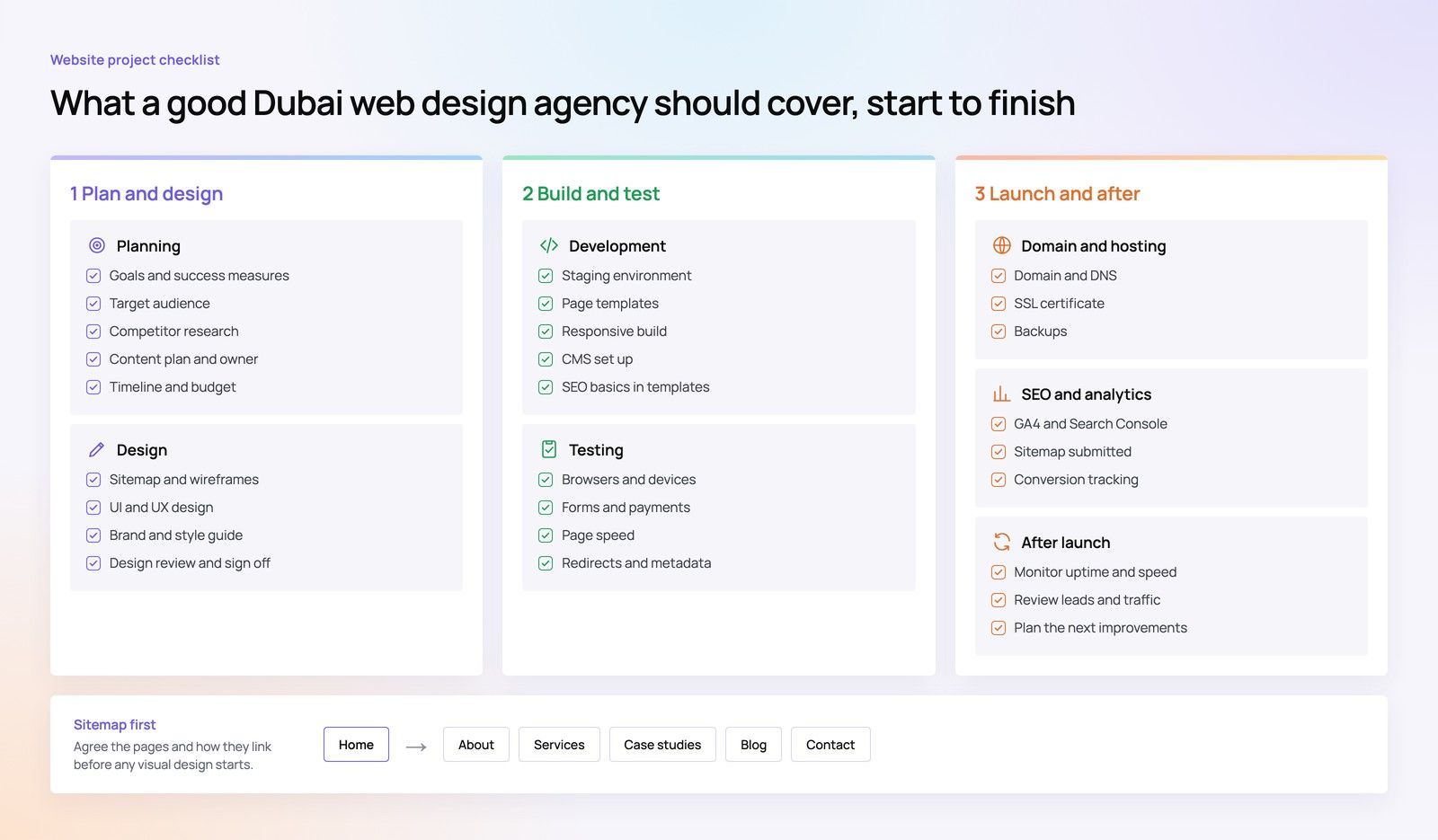
Writing acceptance criteria that can actually be tested
Acceptance criteria turn a deliverable into something that can be passed or failed. Without them, acceptance becomes a matter of opinion, and opinion is where disputes start.
Make each criterion measurable
"The site should be fast" cannot be tested. "Key templates meet the Core Web Vitals thresholds on mobile in the agreed testing tool" can. "The site should be accessible" is vague. "The agreed templates conform to WCAG 2.2 Level AA, checked by the method in Appendix C" is specific. Where a criterion depends on content or third party systems outside the supplier's control, say so.
Define the acceptance process, not only the criteria
- Who tests: name the client roles responsible for user acceptance testing.
- Test window: state how long the client has to test each deliverable.
- Defect classification: agree severity levels, for example critical, major and minor, with definitions.
- Pass rule: state whether acceptance requires zero critical defects, or allows minor issues to be fixed after launch.
- Deemed acceptance: say what happens if the test window closes without feedback. Many contracts treat this as acceptance; agree it explicitly.
Separate defects from new requests
A defect is something that does not meet an agreed criterion. A new request is something that was never agreed. During testing, stakeholders often raise both in the same list. The SOW should state that items not tied to an acceptance criterion go through change control, not the defect log.
Change control that both sides can live with
Change is normal on a website project. Discovery reveals new needs, regulations shift and business priorities move. The goal of change control is not to stop change but to make its impact visible before anyone commits to it.
A simple change control process
- Request: either side raises a change request in writing, describing what is needed and why.
- Impact assessment: the supplier estimates the effect on effort, schedule and other deliverables within an agreed response time.
- Decision: a named client approver accepts, rejects or defers the change.
- Record: approved changes are logged and the scope, plan and budget are updated.
- Delivery: work on the change starts only after approval is recorded.
Useful clauses to include
- A threshold below which small changes can be absorbed without a formal request, with a running log so they do not accumulate unnoticed.
- A statement that verbal instructions are not binding until confirmed through the process.
- A rule that changes to assumptions, such as late content or extra review rounds, are treated as change requests.
- The option to trade scope, so a new item can replace a lower priority one without changing the total effort.
Common gaps that lead to disputes
| Gap in the scope | How it becomes a dispute | How to close it |
|---|---|---|
| Unlimited design revisions | Rounds continue until the schedule breaks | State the number of revision rounds per deliverable |
| "Content migration" without volume | Client expects every page moved; supplier priced a sample | Specify page count, content types and method |
| Integration named but not described | Different assumptions about data, direction and frequency | Attach a short specification for each integration |
| No browser or device list | Issues on an untested device are called defects | List supported browsers and devices in an appendix |
| Silent on language versions | Arabic layout and translation treated as included | State which languages are in scope and who translates |
| Vague warranty | Every post launch request is called a defect | Define the warranty period and what counts as a defect |
How the SOW connects to procurement and evaluation
A strong scope starts during procurement. If you run a tender, the requirements in your request for proposal become the foundation of the SOW, which is why the guidance on running a web agency RFP in the UAE recommends writing requirements in a form that can later be tested. When comparing bids, check how clearly each supplier described its deliverables and assumptions; our weighted framework for scoring website proposals includes this as a criterion.
The scope also needs to match the approved budget. If the business case for the website assumed certain features, confirm they appear in the deliverables, or record the decision to drop them.
Hypothetical example: one clause, two interpretations
Hypothetical example: a scope states that the supplier will "integrate the website with the CRM". The client expects form submissions, newsletter sign ups and event registrations to create records with full campaign tracking. The supplier planned a single form posting basic contact fields. Both readings are reasonable, and neither side is acting in bad faith.
A better clause would name each form, list the fields mapped, state the direction of data flow, describe error handling and give an acceptance test: "a test submission from each named form creates a lead in the CRM sandbox with the mapped fields populated." That version takes a few more lines to write and removes the argument entirely.
Agreeing a clear scope with Codeeo
Codeeo delivers enterprise sites through its website design and development service, along with custom software and business systems where a site needs deeper integration. With 200+ projects delivered across the UAE and the US, the team works through deliverables, assumptions and acceptance criteria with clients before work begins, and UAE clients can meet the team at the Dubai office to review the scope in person. To discuss a project and the scope behind it, get in touch with Codeeo.
Frequently asked questions
Either can draft it, but both must own it.
Agencies often draft the first version because they know which details affect effort. The client should then review it line by line against internal requirements, ideally with input from IT, legal and the business owners of key features. A scope that only one side has read closely is likely to fail when tested.
Digital TransformationReplatforming From Drupal, AEM or .NET Without DowntimeWebsite replatforming from Drupal, AEM or .NET without downtime: choose the target platform, run delta content syncs, plan the cutover and test your rollback. Digital TransformationWhat a Good Enterprise Website SLA ContainsWhat a website maintenance SLA should contain, clause by clause: scope, severity tiers, response and resolution times, uptime, reporting, remedies and exit.
 Digital TransformationTreating Your Website as a Production System: The Case for an SLAWhy a business critical website needs an SLA: hypothetical incident costs, what changes with agreed response times, and how to make the case for support.
Tell us what the business needs. We will tell you what to build first.
Schedule a free consultation and get a written recommendation, with costs, before you commit to anything.
Get in touchPROVEN RESULTS
4.7 / 5verified reviews on Google