 SEORecovering Traffic After a Failed Website MigrationSEO recovery after migration in the right order: diagnose the traffic drop, fix redirects, rebuild internal links, request reindexing, then report progress.
Planning an Enterprise Rebuild That Keeps SEO, UX and Governance
Plan an enterprise website rebuild that protects rankings, user tasks and content governance, with one shared inventory, phase gates and agreed launch criteria.

An enterprise website rebuild keeps its search visibility, its usability and its content standards only when SEO, UX and governance are planned as one programme with shared milestones, not as three teams that meet at launch. The practical answer is a single rebuild plan with one inventory, one decision log and one set of launch criteria that all three workstreams sign. This article sets out how to build that plan for a large organisation.
Why an enterprise website rebuild loses value
Most rebuilds that disappoint do not fail on design or code. They fail at the joins between workstreams. The SEO team writes a redirect map against a sitemap that the UX team has already changed. The UX team simplifies navigation and removes pages that bring in steady search traffic. Governance arrives late, when legal and brand reviewers discover hundreds of pages nobody has approved, and the launch slips while content is rewritten in a hurry.
Each of these is predictable. They happen because each workstream plans against its own picture of the site. The fix is structural: give all three the same source of truth and the same checkpoints.
Three common failure patterns
- The silent cull: pages are removed for being "old" or "thin" without checking whether they earn links, rankings or enquiries.
- The late redirect map: redirects are written in the final fortnight, against URLs that are still changing, and tested only on a sample.
- The ownerless launch: nobody is named as owner for each section after go live, so quality slides within months and the next rebuild is already being discussed.
One plan, three workstreams
An enterprise rebuild plan works best when SEO, UX and governance are treated as lenses on the same set of decisions rather than separate projects. The table below shows how each workstream contributes to every phase.
| Phase | SEO | UX | Governance |
|---|---|---|---|
| Discovery | Baseline rankings, traffic, links and indexed URLs | Analytics on key tasks, user research, accessibility review | Content owners, approval chains, regulatory constraints |
| Architecture | URL patterns, internal linking, keep or merge decisions | Navigation, page templates, task flows | Who signs off structure, naming and section ownership |
| Build | Template checks for titles, canonicals, structured data, rendering | Prototype testing, component behaviour, performance budgets | Workflow and permissions in the CMS, content standards |
| Content migration | Redirect map, metadata carried over, hreflang | Content fits the new templates and reading patterns | Legal, brand and translation approval |
| Launch | Crawl of staging and live, redirect tests, sitemaps | Task testing on real devices | Go or no go sign off against agreed criteria |
| After launch | Monitoring indexing, errors and traffic by section | Behaviour analytics and feedback loops | Review cycles, owners, retirement rules |
Every phase has an output from all three workstreams, and the phase does not close until all three are done.
Discovery: build a single source of truth
Before any wireframe, create one URL inventory that every team works from. A spreadsheet or database is fine; what matters is that it is shared and versioned.
What the inventory should hold for each URL
- Current URL, page type and section.
- Organic clicks and impressions from Search Console over at least a full year, so seasonal pages are not mistaken for dead ones.
- Referring domains and notable external links.
- Conversions or enquiries attributed to the page in analytics.
- Content owner and last review date.
- Language versions and their counterparts.
- Proposed action: keep, merge, rewrite or retire, with the new URL where relevant.
The proposed action column is where the three workstreams negotiate. UX may want to merge five similar service pages into one. SEO checks which of them carry rankings. Governance confirms who can approve the merged text. The decision and the reason are written in the same row, so nobody has to reconstruct the logic six months later.
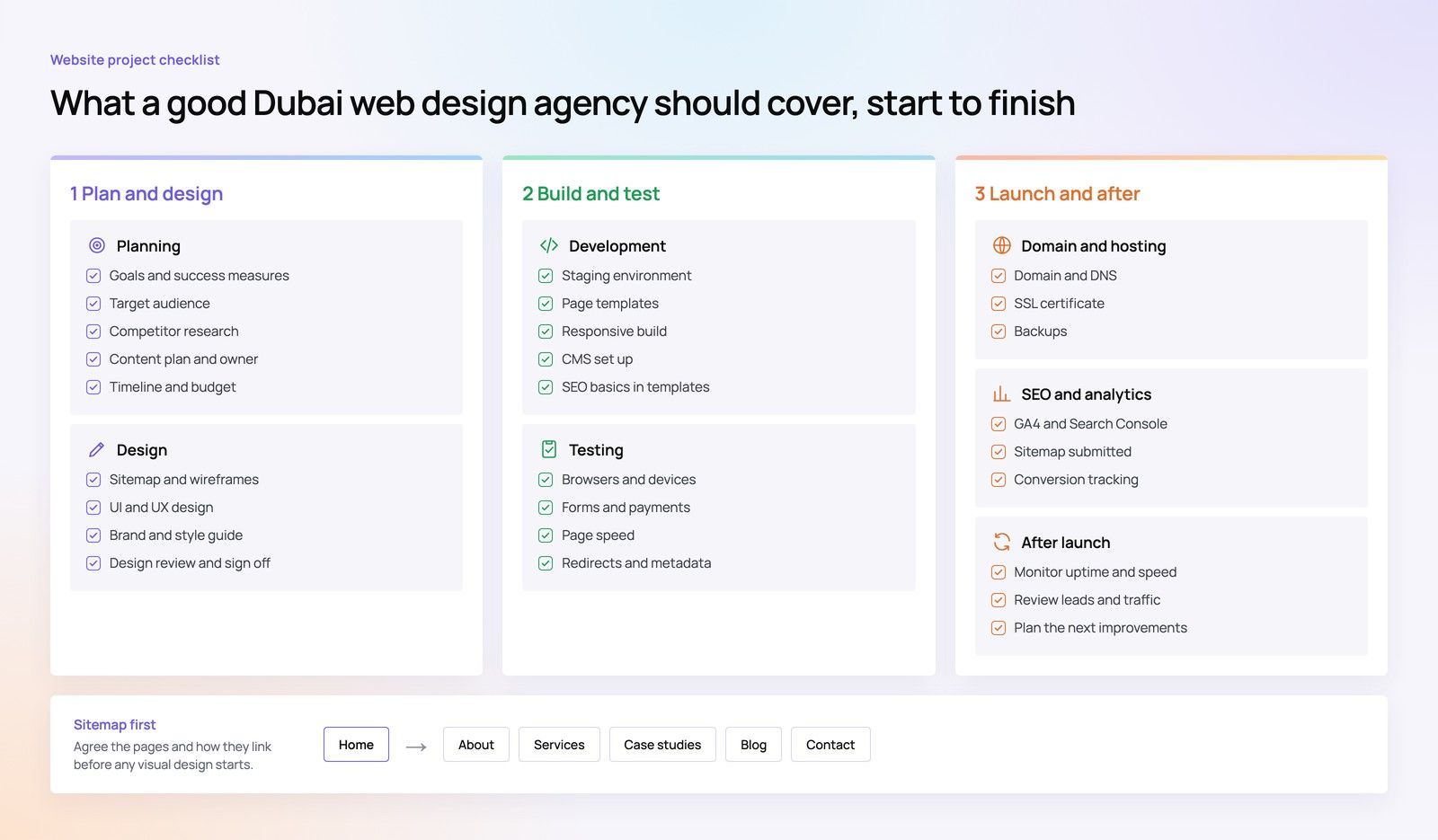
Agree baselines before anything changes
Record the numbers you will judge the rebuild against: organic traffic by section, top landing pages, conversion rates on key tasks, Core Web Vitals field data and accessibility issues. Without a baseline, every post launch dip turns into an argument about whether it is real.
SEO migration in an enterprise context
SEO migration at enterprise scale is mostly disciplined bookkeeping. Google's own guidance on site moves with URL changes recommends server side permanent redirects, such as 301 or 308, from each old URL to its closest new equivalent, and warns against sending many old URLs to one unrelated page such as the home page. It also advises keeping redirects in place for as long as possible, generally at least a year, and updating internal links, canonical tags and hreflang annotations to point at the new URLs. The full guidance is on Google Search Central.
Practical rules for large sites
- Change URLs only when there is a clear reason. Every changed URL is a redirect to maintain and a signal Google has to transfer.
- Write the redirect map from the inventory, not from memory, and lock the URL list under change control a set period before launch.
- Test every redirect, not a sample. On a large site, a script that requests each old URL and checks the status and destination is standard practice.
- Avoid redirect chains by pointing old URLs straight at their final destination.
- If the domain itself changes, Search Console's Change of Address tool applies; for path changes on the same domain it does not.
Google also notes that rankings can fluctuate while a moved site is recrawled, and that larger sites take longer to settle. Set that expectation with leadership early, so a temporary dip is not treated as a crisis. If a dip does turn into a real loss, the triage order in our guide to recovering traffic after a failed migration applies. For the final checks before go live, see our pre launch migration audit.
UX continuity: change what helps, keep what works
UX continuity means returning users can still complete the tasks they came for, even if the site looks different. A large organisation's website often has loyal audiences: investors checking reports, suppliers downloading forms, patients booking appointments, students looking for admissions dates.
Protect the top tasks
Use analytics and site search logs to list the ten or so tasks that account for most visits. Each one gets a named path in the new design, a prototype test with real users, and a check at launch. If a task moves, the old route should still lead there through a redirect, a clear link or a search result.
Treat performance and accessibility as design decisions
Template choices decide most of a page's speed and accessibility. Agree performance budgets for each template during design, not after build, and review components against accessibility standards before they are reused across hundreds of pages. Our UI/UX design team works this way so that a fault is fixed once in a component, not page by page.
Where UX and SEO disagree
Conflicts are normal and healthy. Common ones include:
- Navigation depth: UX wants fewer menu items; SEO wants important sections linked prominently. A compromise is a lean main menu with strong hub pages and contextual links.
- Tabs and accordions: useful for scanning, but content should still be present in the page source and readable without interaction.
- Merged pages: fewer, better pages are usually right, provided the merged page answers the queries the old pages ranked for.
Record each decision in the inventory or decision log with the reasoning, so the debate does not restart with every new stakeholder.
Content governance: decide who owns what
Content governance is the set of rules for who creates, approves, updates and retires content. Rebuilds are the best moment to fix it, because every page is being touched anyway.
The minimum governance model
- Section owners: one named person per section, accountable for accuracy and review dates.
- Approval paths: who reviews for brand, legal, compliance and translation, and in what order.
- Standards: a short style guide covering tone, headings, link text, image alt text and metadata.
- CMS roles: permissions that match the approval paths, so the workflow is enforced by the system rather than by goodwill.
- Review and retirement: a cycle for checking pages and a rule for removing or redirecting outdated ones.
Regulated sectors in the UAE
Organisations in healthcare, financial services or education often have extra review steps for public content and for any forms that collect personal data. The UAE Personal Data Protection Law (Federal Decree-Law No. 45 of 2021) applies generally, while entities in the DIFC or ADGM have their own data protection regimes. Build the relevant reviews into the governance model from the start, and confirm specific obligations with your legal counsel or the relevant regulator rather than relying on the project team's reading.
Running the programme
An enterprise rebuild plan needs a light but real operating rhythm.
- One programme lead who owns the combined plan and the decision log.
- A weekly joint review where SEO, UX and governance leads look at the same inventory and open decisions.
- Phase gates that cannot close until each workstream has signed its output.
- A change process for anything that alters URLs, templates or approval paths after they are agreed.
- Agreed launch criteria, written early, so the go or no go meeting is a check rather than a negotiation.
Hypothetical example: a Dubai based group with separate websites for five business units decides to consolidate onto one platform. In discovery, the shared inventory shows that two of the smaller sites hold most of the group's organic enquiries through a few long standing guide pages. UX had planned to fold those guides into a general resources hub. Because the data sits in the same row as the proposal, the team keeps the guides as distinct pages within the hub, maps their URLs one to one and assigns each a section owner. The decision takes one meeting instead of a post launch investigation.
Launch criteria worth agreeing in advance
- All redirects in the map tested and returning the expected destination.
- No unexpected blocking in robots rules or noindex tags on live templates.
- XML sitemaps listing the new URLs submitted in Search Console.
- Top tasks completed successfully in testing on mobile and desktop.
- Every section has a named owner and a first review date.
- Analytics and conversion tracking verified on the new templates.
After launch: the first ninety days
Monitoring is where the three workstreams prove the plan worked. Track indexing and crawl errors in Search Console, traffic and conversions by section against the baseline, and task completion through analytics and feedback. Hold short weekly reviews for the first month, then move to a monthly rhythm. Governance should already be running: owners reviewing their sections, and requests for new pages going through the agreed path.
It is also the right time to plan how the new site will be measured over the year, a topic we cover in what drives enterprise SEO cost, and to consider how AI tools fit into ongoing content and search work, discussed in how AI is changing web design and SEO.
Plan your enterprise website rebuild with Codeeo
Codeeo has delivered more than 200 projects across the UAE and the US, with a team of 80+ across Dubai, Riyadh and Karachi. Our website design and development, UI/UX design and digital marketing and SEO teams can work as one programme on a rebuild, and our site migration service covers the inventory, redirect mapping and launch checks. If you want a view of where your current site stands first, start with a technical SEO review. Our office is in Dubai, so UAE teams can meet us in person. Contact Codeeo to talk through your rebuild.
Frequently asked questions
It is usually safer to separate them.
Each change gives search engines more to process, and if traffic drops it becomes hard to tell which change caused it. If a domain change is unavoidable, keep URL paths as stable as possible, use the Change of Address tool in Search Console for the domain move, and allow extra monitoring time after launch.
SEORecovering Traffic After a Failed Website MigrationSEO recovery after migration in the right order: diagnose the traffic drop, fix redirects, rebuild internal links, request reindexing, then report progress. SEOProtecting Lead Flow During a Redesign, Not Only RankingsAvoid a website redesign conversion drop: map lead paths, rebuild form tracking, protect ad landing pages and test CRM integration before and after launch day.
 SEOPre Launch Migration Audit: Final Checks Before Go LiveWebsite migration audit for launch week: staging crawl, redirect testing, tracking and CRM checks, rollback triggers and a go live checklist for the day itself.
Tell us what the business needs. We will tell you what to build first.
Schedule a free consultation and get a written recommendation, with costs, before you commit to anything.
Get in touchPROVEN RESULTS
4.7 / 5verified reviews on Google