 SEORecovering Traffic After a Failed Website MigrationSEO recovery after migration in the right order: diagnose the traffic drop, fix redirects, rebuild internal links, request reindexing, then report progress.
Server Location, Latency and Core Web Vitals for UAE Sites
How hosting location affects SEO for UAE sites: what server distance and a Middle East CDN do to TTFB and Core Web Vitals, and how to measure the lead impact.

Hosting location SEO comes down mainly to speed: the further a server sits from UAE visitors, the longer each request takes, which raises time to first byte (TTFB) and delays everything that loads after it. Server location is not a direct ranking factor in its own right, but the latency it adds feeds into Core Web Vitals and into how quickly a visitor sees a page they can act on. A CDN with nearby edge locations often closes most of that gap without moving the origin server.
Hosting location SEO in practice
Google's guidance on page experience says its ranking systems use Core Web Vitals, while also stating that relevance comes first and that good scores alone do not guarantee top rankings. So the realistic way to think about hosting location SEO is this: a distant server rarely stops a strong page from ranking, but it can make the page slower than competitors for the people you want to convert.
The chain of cause and effect runs like this:
- Distance and network routing add round trip time to every connection.
- Connection setup (DNS, TCP and TLS) needs several round trips before any content moves.
- Those delays raise TTFB.
- TTFB comes before First Contentful Paint and Largest Contentful Paint, so every millisecond added at the start pushes those metrics back.
- Slower pages, particularly on mobile data, give visitors more time to give up before a form, call button or WhatsApp link appears.
What TTFB measures and what counts as good
TTFB is the time from the start of navigation until the first byte of the response arrives. According to web.dev's TTFB guide, it includes redirects, DNS lookup, connection and TLS negotiation, and the request up to the first byte, which covers server processing. The same guide gives 0.8 seconds or less as a rough guide for good, and above 1.8 seconds as poor.
Two points are worth keeping in mind:
- TTFB is not a Core Web Vital. It matters because it sits underneath LCP. A server rendered page with a moderate TTFB can still achieve a good LCP; a client rendered app with the same TTFB may not.
- Distance is only one part of TTFB. A slow database query, an uncached CMS page or a chain of redirects can add more delay than geography does.
The Core Web Vitals thresholds
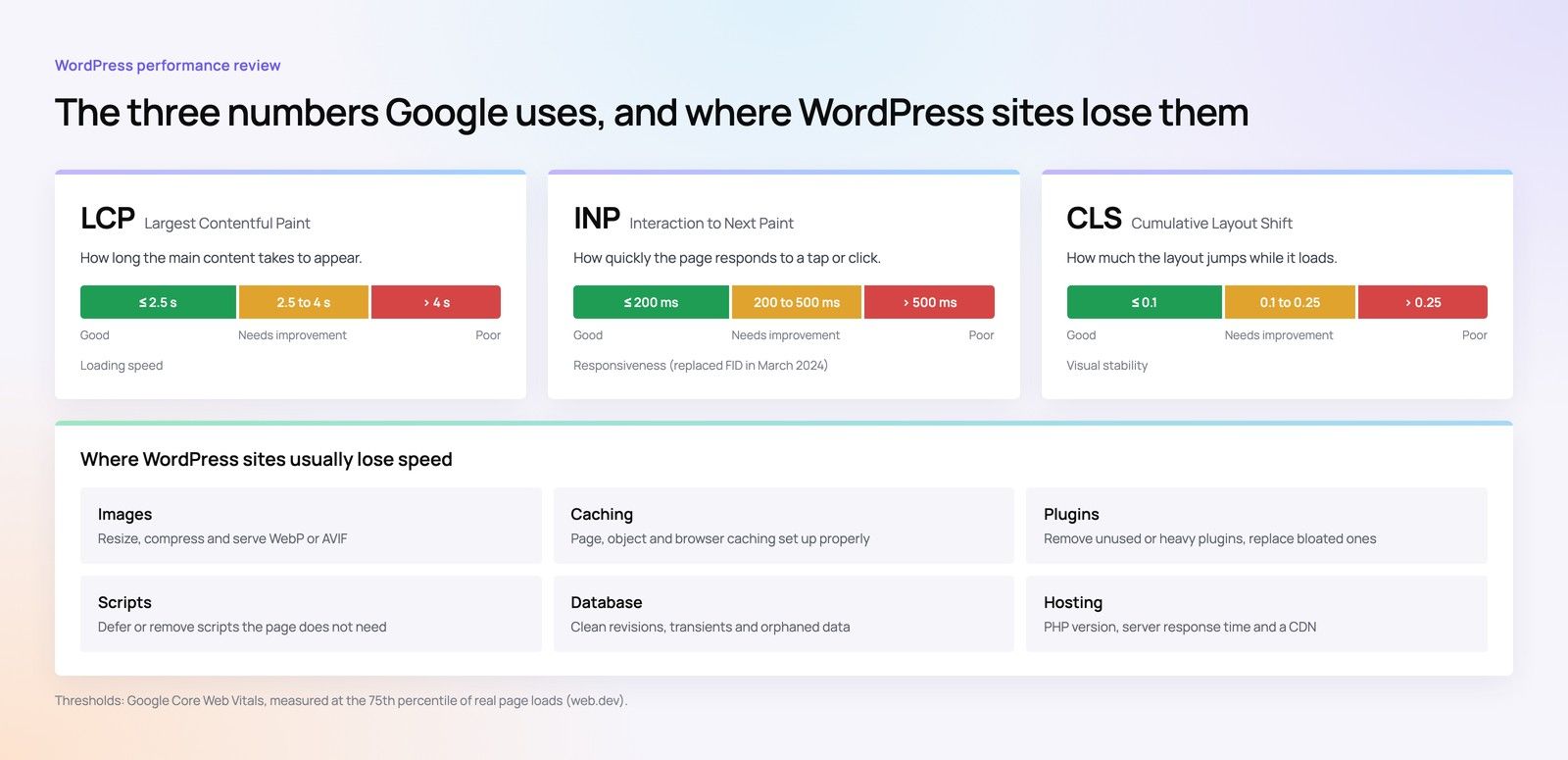
The published Core Web Vitals thresholds for a good experience are LCP of 2.5 seconds or less, Interaction to Next Paint of 200 milliseconds or less, and Cumulative Layout Shift of 0.1 or less, assessed at the 75th percentile of page loads. Hosting location mostly affects LCP; INP and CLS are driven by the front end code.
UAE hosting latency: origin, CDN or both
For a site whose visitors are mainly in the UAE and the wider Gulf, there are three common setups.
| Setup | Effect on UAE latency | Watch out for |
|---|---|---|
| Origin in Europe or the US, no CDN | Every request travels the full distance, so TTFB is highest | Mobile visitors feel it most; dynamic pages suffer on every load |
| Distant origin with a CDN that has Middle East edge locations | Cached pages and assets are served from nearby edge servers | Uncached or personalised pages still go back to the origin |
| Origin in the UAE or a nearby Gulf region, with or without a CDN | Short distance for every request, including uncached ones | Provider choice, cost of ownership and support quality vary |
Why a CDN in the Middle East often matters more than the origin
The web.dev guide to optimising TTFB recommends a CDN for sites with users far from the origin, because edge servers physically closer to users can serve cached content without a trip to the origin. For a marketing site where most pages are the same for every visitor, full page caching at the edge can make the origin's location almost irrelevant for most visits. Check that your CDN provider actually has edge locations in or near the UAE, and that it is configured to cache HTML pages, not only images and scripts.
When the origin location still matters
- Ecommerce carts, checkouts and account areas, which cannot be cached at the edge.
- Search, filters and booking tools that query the server on every request.
- Logged in portals such as LMS or HR systems used by staff in the UAE.
- Personal data rules. Where data is stored can raise questions under the UAE PDPL (Federal Decree-Law No. 45 of 2021) or sector rules. That is a legal question rather than a speed one, so confirm requirements with counsel or the relevant regulator.
How to measure the effect on your own site
Do not rely on a single speed test run from an unknown location. Measure from where your visitors are, then compare setups.
Step 1: check field data first
Search Console's Core Web Vitals report and the Chrome UX Report show what real visitors experience. If LCP is already good for mobile users, hosting changes are unlikely to be the priority.
Step 2: run lab tests from a nearby location
Use a testing tool that lets you choose a test location in or close to the UAE, and compare it with a test from the server's own region. A large gap in TTFB between the two points to distance; a slow TTFB in both points to the server or application.
Step 3: separate cached and uncached responses
Caching can hide a slow backend. web.dev suggests having a way to bypass the CDN and caches so you can see the true server time. Test the homepage, a service page, a blog post and any dynamic page such as a cart or search result.
Step 4: remove redirects before blaming geography
Redirects are a common contributor to high TTFB. An HTTP to HTTPS redirect followed by a www redirect and a trailing slash redirect adds a full round trip for each hop. Fixing these is cheaper than moving hosting.
Step 5: connect speed to leads
Speed only matters commercially if it changes behaviour. Segment conversion rate in analytics by device and by page load speed band, and compare before and after any hosting or CDN change. Track forms, calls and WhatsApp clicks, not only page views.
Hypothetical example: a Dubai services firm hosts its WordPress site on a shared server in Europe with no CDN. Lab tests from a UAE location show a slow TTFB on every page, while tests from Europe look fine. Rather than migrate immediately, the team adds a CDN with Gulf edge locations, enables full page caching for public pages and removes a redirect chain on the homepage. They then compare mobile LCP in field data and enquiry rates over the following weeks before deciding whether the origin also needs to move.
A decision checklist for hosting and CDN choices
- Where are most of your visitors, by analytics, not by assumption?
- What share of your pages can be fully cached at the edge?
- Does your CDN have edge locations near the UAE, and is HTML caching switched on?
- Are there dynamic areas (checkout, booking, portals) that need a nearby origin?
- Have redirects, uncached CMS queries and heavy plugins been fixed first?
- Are there data storage requirements that point to a specific region?
- Who monitors TTFB and Core Web Vitals after the change?
Search engines and their guidance keep changing, so treat these checks as a regular review rather than a one off; our guide to keeping up with SEO changes covers how to do that without chasing every update. For businesses that also depend on map listings, fast mobile pages support the work described in local SEO for Dubai service businesses. Enterprise platforms raise their own hosting questions, discussed in SEO on Adobe Experience Manager sites, and the brief level requirements are in technical SEO requirements for a development brief.
Getting a faster site for UAE visitors
Codeeo's Core Web Vitals service and speed optimisation quick start look at hosting, CDN configuration, caching and front end code together, so effort goes where the delay actually is. If a move to new hosting is needed, our site migration service covers the switch and the redirects. With an office in Dubai, our team can review results with you in person. Contact us to talk about your site's speed.
Frequently asked questions
No.
The domain extension and the server location are separate choices. A .ae domain already signals a UAE focus to search engines, and a site on that domain can be hosted anywhere. The hosting decision should be made on speed, reliability, support and any data storage requirements, rather than to match the domain extension.
SEORecovering Traffic After a Failed Website MigrationSEO recovery after migration in the right order: diagnose the traffic drop, fix redirects, rebuild internal links, request reindexing, then report progress. SEOPlanning an Enterprise Rebuild That Keeps SEO, UX and GovernancePlan an enterprise website rebuild that protects rankings, user tasks and content governance, with one shared inventory, phase gates and agreed launch criteria.
 SEOProtecting Lead Flow During a Redesign, Not Only RankingsAvoid a website redesign conversion drop: map lead paths, rebuild form tracking, protect ad landing pages and test CRM integration before and after launch day.
Tell us what the business needs. We will tell you what to build first.
Schedule a free consultation and get a written recommendation, with costs, before you commit to anything.
Get in touchPROVEN RESULTS
4.7 / 5verified reviews on Google