 Digital TransformationReplatforming From Drupal, AEM or .NET Without DowntimeWebsite replatforming from Drupal, AEM or .NET without downtime: choose the target platform, run delta content syncs, plan the cutover and test your rollback.
CodeeoInsightsDigital Transformation
UAE Region Cloud Hosting: Data Residency and Latency
UAE cloud hosting explained: when local data residency is required or advisable, what a UAE region changes for latency, and which rules to confirm officially.

UAE cloud hosting means running your website or application in a cloud region physically located in the country rather than in Europe, Asia or the US. Whether you need it depends on the data the site handles, the sector you operate in and where your visitors are; for some regulated organisations it is close to mandatory, while for many others it is a sensible choice that mainly improves speed for local users. This guide sets out how to decide, what changes for latency, and which claims to confirm with the official body before you commit.
When UAE cloud hosting is required, advisable or optional
There is no single rule that every UAE website must be hosted in the country. The answer comes from layering three questions: what personal data you process, which legal regime applies to your organisation, and whether a sector regulator or contract sets its own expectations.
| Situation | Typical position | Who to confirm with |
|---|---|---|
| Brochure site with no forms or logins | Optional; decide on speed and cost | Internal IT |
| Corporate site collecting enquiries and job applications | Advisable to know and document where data sits | Counsel, data protection lead |
| Ecommerce or customer portal with accounts | Advisable; check cross border transfer conditions | Counsel |
| Health related services or patient data | Local storage may be expected; check sector rules | Dubai Health Authority, Department of Health Abu Dhabi, or the federal health ministry as relevant |
| Banking, insurance or payments | Regulator expectations on outsourcing and cloud likely apply | Central Bank of the UAE or relevant financial regulator |
| Government and semi government entities | Internal or emirate level policies often apply | The entity's information security function |
Treat this table as orientation, not legal advice. Rules and their interpretation change, and the official regulator or your counsel should confirm the position for your organisation.
UAE data residency: the legal layers
UAE data residency questions start with which data protection regime applies. The UAE has a federal law and separate regimes in its two financial centres, plus sector rules on top.
The federal data protection law
The Federal Decree-Law No. 45 of 2021 on the Protection of Personal Data sets general rules for processing personal data, including conditions for transferring it outside the country. Summaries of the law describe transfers as permitted in defined circumstances, for example to countries with adequate protection or with appropriate safeguards. The law does not, on most readings, require all personal data to stay in the UAE, but it does mean you should know where data goes and why that is acceptable. Detailed implementing rules were left to executive regulations, so confirm their current status with the UAE Data Office or counsel.
DIFC and ADGM
Businesses established in the Dubai International Financial Centre or Abu Dhabi Global Market fall under those centres' own data protection laws, each with its own transfer rules and regulator. If you operate there, use the relevant commissioner's guidance rather than the federal law as your reference point.
Sector rules
Some sectors carry stricter expectations. UAE health data legislation is widely reported to include data localisation provisions for health information, with limited exceptions, and financial regulators set requirements on outsourcing and cloud use. These are exactly the areas where a dated, sourced answer from the regulator matters more than a general article. Confirm with the Dubai Health Authority, the Department of Health Abu Dhabi, the Central Bank of the UAE or your counsel, as relevant. If you are building a site for a clinic or hospital, Codeeo's healthcare work starts from that confirmation.
What a local cloud region actually changes
A local cloud region gives you servers, storage and managed services inside the country. Both major providers now run UAE regions: AWS has a Middle East (UAE) Region and Microsoft runs Azure UAE North in Dubai, with UAE Central in Abu Dhabi. The comparison in AWS or Azure in the UAE for enterprise websites covers the choice between them.
What it does not change on its own
- Third party tools. Analytics, tag managers, chat widgets, email platforms and CRMs may store data elsewhere, even if the website itself runs locally.
- Backups and replicas. A backup copied to another region by default moves data out of the country.
- Logs and monitoring. Log and monitoring services may process request data, including IP addresses, in another region.
- Support access. Provider or agency staff may access systems from outside the UAE; contracts and access controls should cover this.
- AI services. Some AI features run only in specific regions, so prompts containing personal data could leave the country. See enterprise AI integration inside compliance boundaries.
A data flow map that lists every component, where it runs and what data it touches is the most useful document you can produce before choosing hosting.
AWS UAE region and Azure UAE region: practical checks
Choosing the AWS UAE region or an Azure UAE region is only the first step. Newer regions often launch with a core set of services and add more over time, so check each component against the official lists.
- Confirm service availability. Use the AWS regional services list and Microsoft's Azure products by region page for every service, tier and feature you plan to use.
- Set default regions deliberately. Configure storage, backups and logs to stay in the chosen region unless you have documented a reason to replicate elsewhere.
- Plan recovery. Decide whether disaster recovery copies will sit in a second UAE region, a nearby region, or another zone within the same region, and record why.
- Check the CDN. A content delivery network caches content at edge locations, some of which may be outside the UAE. For public pages this is usually fine; for personalised or logged in content, check caching rules.
- Record it. Keep a dated note of what you checked and where, so auditors and future teams can see the basis for the decision.
Region details, including the number of zones and access conditions for secondary regions, change. Confirm them with AWS or Microsoft directly before procurement rather than relying on summaries, including this one.
Latency: what local hosting does for speed
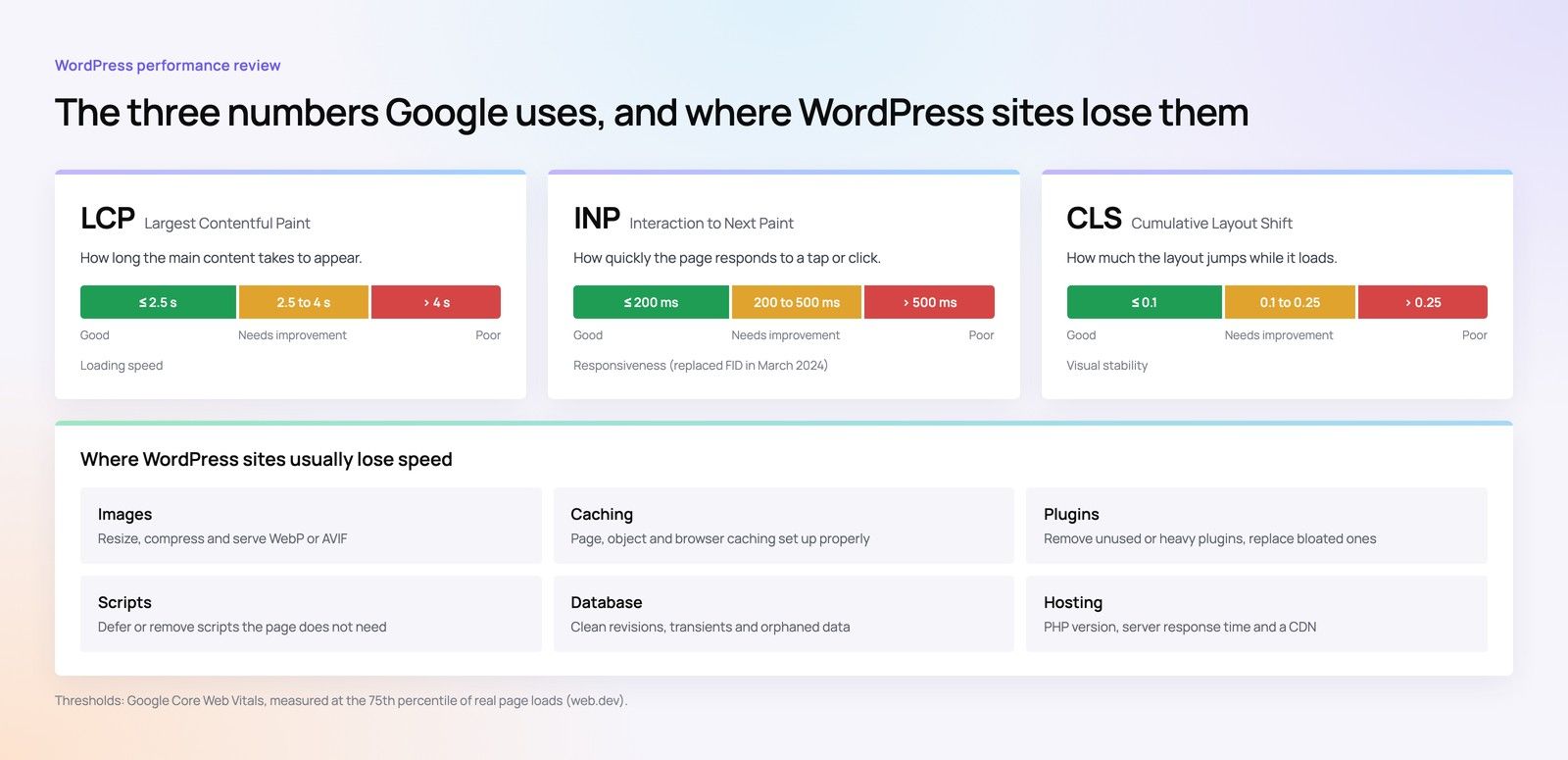
Data travels at a finite speed, and each request between a visitor and a server takes a round trip. When the server is far away, every round trip adds delay, and a page that needs several sequential requests before it can display multiplies that delay. Hosting close to your visitors shortens those trips.
Where the gain is real
- Dynamic pages. Search results, account pages, checkout and personalised content cannot be cached at the edge, so the origin server's location shows up directly in Time to First Byte.
- APIs and forms. Form submissions, booking engines and app backends benefit from a nearby origin.
- Admin work. Editors working in the CMS from the UAE feel the difference on every save and preview.
Where the gain is small
- Cached static content. Images, scripts and cached HTML served from a CDN edge near the visitor already arrive quickly, whatever the origin.
- International audiences. If many visitors are in Europe, South Asia or North America, a UAE origin may be slower for them, and a CDN with good edge coverage matters more.
- Slow code. A heavy theme, unoptimised images or too many third party scripts will cancel out any network gain. Fix those first; the speed optimisation quick start and Core Web Vitals service focus on exactly this.
Hypothetical example: a Dubai retailer hosts its online store in a European region. Product pages load acceptably because they are cached, but account pages and checkout feel sluggish for UAE shoppers because each request travels to Europe and back. Moving the origin to a UAE region improves those dynamic steps, while the CDN continues to serve images and static assets as before.
A decision checklist for UAE cloud hosting
- List the personal data the site collects and where each item is stored, processed and backed up.
- Identify the applicable regime: federal law, DIFC or ADGM, plus any sector regulator.
- Get a dated, written view from counsel or the regulator where sector rules may require local storage.
- Confirm every required cloud service is available in the chosen UAE region.
- Decide on recovery locations and document the reason.
- Review third party tools for where they store data.
- Measure current performance for UAE visitors before and after any move.
- Plan the move as a site migration with redirects, DNS and rollback covered.
Hosting location also affects vendor evaluation. If you are selecting an implementation partner for a large platform, the guide to evaluating Sitecore partners for listed companies covers how to test their hosting and residency answers, and WordPress VIP or self hosted enterprise WordPress looks at the same question for WordPress.
Build the site around the residency decision
Residency and latency choices are easiest to get right before development starts, when architecture, plugins and integrations are still open. Codeeo's website development team can design the site and its integrations around the hosting region you and your counsel settle on, and set up the configuration on your chosen cloud. Codeeo has delivered 200+ projects across the UAE and the US and has an office in Dubai where you can meet the team. Contact Codeeo to plan your next build or move.
Frequently asked questions
Not automatically.
Analytics, email marketing, CRM, chat and monitoring tools often run in other regions, and backups or logs may replicate elsewhere by default. To keep data local you need to configure each component and choose suppliers accordingly, then record the result in a data flow map. Some transfers may still be acceptable under the applicable law if conditions are met.
Digital TransformationReplatforming From Drupal, AEM or .NET Without DowntimeWebsite replatforming from Drupal, AEM or .NET without downtime: choose the target platform, run delta content syncs, plan the cutover and test your rollback. Digital TransformationWhat a Good Enterprise Website SLA ContainsWhat a website maintenance SLA should contain, clause by clause: scope, severity tiers, response and resolution times, uptime, reporting, remedies and exit.
 Digital TransformationTreating Your Website as a Production System: The Case for an SLAWhy a business critical website needs an SLA: hypothetical incident costs, what changes with agreed response times, and how to make the case for support.
Tell us what the business needs. We will tell you what to build first.
Schedule a free consultation and get a written recommendation, with costs, before you commit to anything.
Get in touchPROVEN RESULTS
4.7 / 5verified reviews on Google