 Digital TransformationReplatforming From Drupal, AEM or .NET Without DowntimeWebsite replatforming from Drupal, AEM or .NET without downtime: choose the target platform, run delta content syncs, plan the cutover and test your rollback.
CodeeoInsightsDigital Transformation
Enterprise AI Integration Inside Compliance Boundaries
Enterprise AI integration patterns for UAE firms: workflow automation, LLM gateways and CRM AI steps built around data residency, approvals and audit logs.

Enterprise AI integration inside compliance boundaries means designing every workflow, model call and CRM step around three questions: where the data goes, who approves what the AI produces, and what is recorded. Start with the boundary, then pick the pattern. This guide covers practical implementation patterns for UAE organisations that already have an AI policy and now need to build within it.
From policy to build: what the boundary looks like
Governance decides what is allowed; integration decides how. If your organisation has worked through the questions in the guide to AI governance for business websites, you should already have risk tiers, owners and logging rules. Before any build starts, turn those into a one page boundary statement for the project.
| Boundary | Question to answer | Example decision |
|---|---|---|
| Data residency | Where may this data be stored and processed? | Customer records stay in the UAE region; anonymised text may go to an approved overseas model |
| Data minimisation | What is the least data the model needs? | Send the enquiry text, not the full CRM record |
| Approval | Which outputs need a human before they take effect? | Drafted emails to clients need approval; internal tags do not |
| Vendors | Which models and tools are approved? | One cloud model service and one workflow platform |
| Logging | What is recorded and where? | Prompts, outputs and approvals stored with CRM activity history |
With this table agreed, technical choices become much easier. Every proposed workflow is checked against it.
Data residency for AI: the first design decision
Data residency AI questions decide architecture more than any other factor. UAE organisations may face residency expectations from sector regulators, contracts, government clients or internal policy, and the federal PDPL and the DIFC and ADGM regimes set conditions on transfers of personal data. Confirm the rules that apply to your sector with counsel or the relevant regulator before choosing a design.
Where AI processing actually happens
An AI workflow has several places data can sit:
- The source system, such as the website, CRM or ERP.
- The workflow or automation platform that moves data between steps.
- The model provider that processes prompts and returns outputs.
- Any vector database or search index used for retrieval.
- Logs at every one of these points.
Each needs a known location. Vendor documentation is the place to check. For example, Microsoft's data privacy page for its Azure OpenAI service explains how data handling depends on the deployment type chosen, with some deployment types able to process data outside the resource's geography. Read the current version of such pages for every vendor, because options and terms change.
Three residency patterns
- In region processing. Models and data stay in a UAE cloud region where the vendor offers it. Simplest to defend; model choice may be narrower. The article on UAE region cloud hosting covers the hosting side.
- Redact, then send. Personal data is removed or replaced with tokens inside your environment before text reaches an overseas model, and restored on return.
- Split by tier. Low risk tasks such as drafting public content use any approved model; tasks touching personal or regulated data use in region services only.
Pattern 1: workflow automation with an orchestration layer
Most enterprise AI integration is not a chatbot. It is a workflow: an event happens, data is collected, a model does one well defined task, and the result moves to the next system. An orchestration layer such as n8n, Power Automate or a custom service holds that logic.
Why the orchestration layer matters for compliance
The orchestration layer is where boundaries are enforced. It decides which fields are passed to the model, where outputs are stored and when a human is asked to approve. Putting this logic in one place, rather than scattering model calls across plugins and scripts, makes it auditable.
n8n automation and self hosting
n8n automation is popular with enterprise teams partly because the n8n documentation describes self hosting on your own infrastructure, on premises or in a private cloud, as well as a managed cloud option. Self hosting lets you place the workflow engine and its execution logs in the region you choose. It also makes you responsible for patching, access control, backups and monitoring, so budget the operational effort. Check n8n's current licensing terms for the features you need.
Design rules for automated workflows
- One workflow, one purpose. Avoid long chains where a model's output silently feeds another model.
- Pass named fields, never whole records.
- Store credentials in the platform's secret store, not inside workflow steps.
- Log each execution with input reference, output and status.
- Add an explicit approval step wherever the boundary statement requires one.
Pattern 2: direct LLM integration in your own applications
LLM integration through a vendor API suits features that need tight control, such as a website assistant, a document summariser in a client portal or classification inside a custom system.
Build a model gateway
Rather than calling models from many places, route every call through a small internal gateway service. The gateway:
- Applies redaction rules before text leaves your environment.
- Selects the approved model and region for the request's risk tier.
- Attaches the current prompt version and records it.
- Logs inputs, outputs and latency, with personal data minimised.
- Enforces rate limits and blocks requests that break policy.
When a vendor changes terms or a better model appears, you change one service instead of every application.
Retrieval with boundaries
Retrieval augmented generation lets a model answer from your own documents. Keep the index in an approved location, respect document permissions so users only retrieve what they are allowed to see, and record which sources each answer used. A retrieval system that ignores permissions is a data leak waiting to happen.
Pattern 3: AI steps inside CRM processes
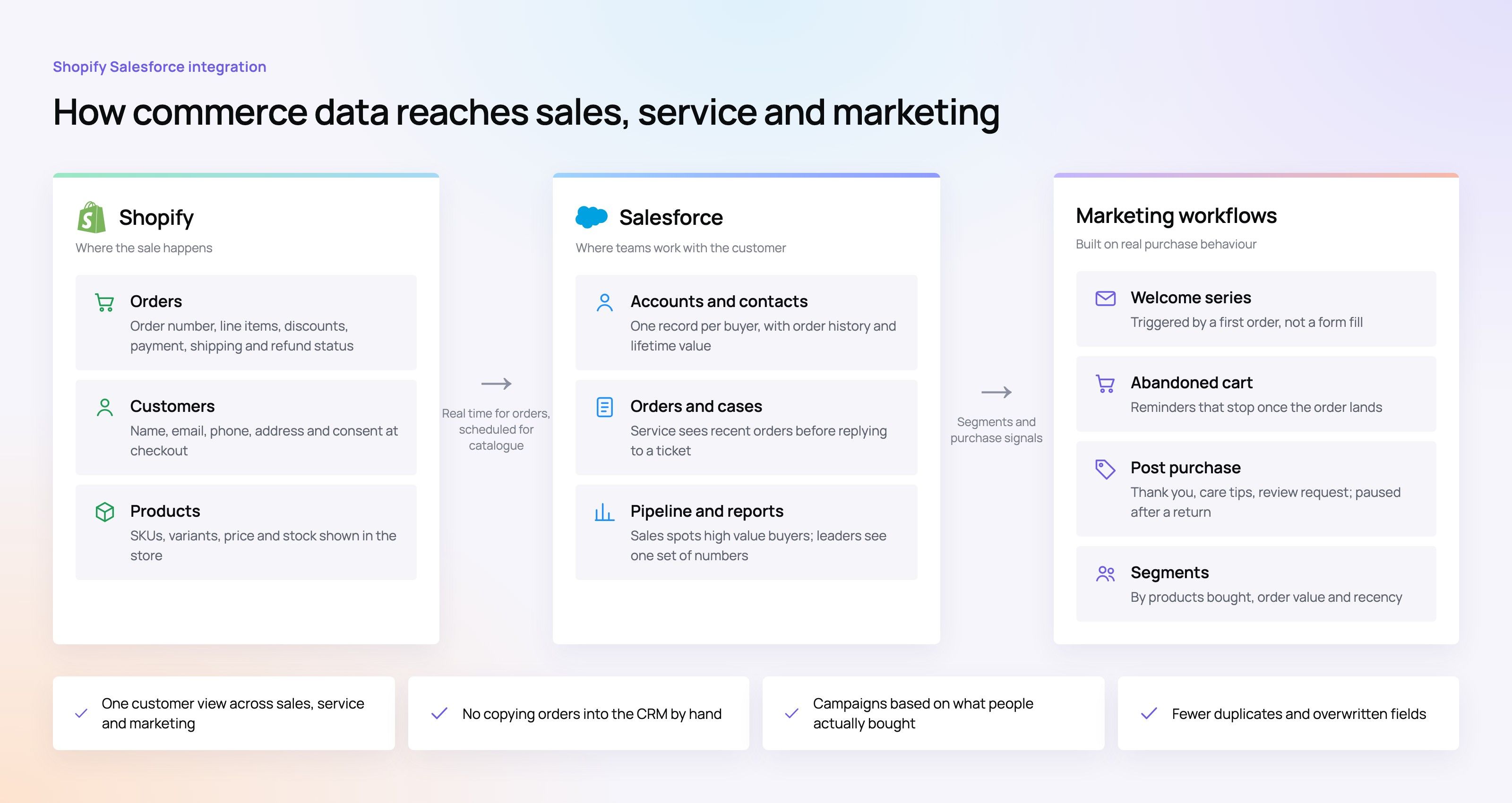
CRM platforms are adding native AI features. HubSpot AI workflows, Microsoft Dynamics 365 and Salesforce all offer ways to summarise records, draft emails or score leads inside the CRM. Native features are convenient, but they still need to fit your boundary.
Questions to ask before switching on a native CRM AI feature
- Which model provider processes the data, and in which region?
- Is customer data used to train or improve the vendor's models?
- Can the feature be limited to certain teams, objects or fields?
- Are AI generated changes recorded in the audit history?
- Does it act automatically, or does it suggest and wait for a user?
Check the answers in the vendor's current documentation and contract, and confirm what your subscription tier includes, since AI features and data handling often differ by plan and region.
Suggest, do not act
The safest default for CRM AI is suggestion mode. The model drafts a reply, a summary or a next step; a person accepts or edits it. Automatic actions, such as changing a deal stage or sending an email, should be reserved for low risk tasks with clear rules and full logging.
Hypothetical example: a property developer's website sends enquiries into the CRM. A workflow redacts phone numbers and emails, asks an approved model to classify the enquiry by project and intent, and writes the classification back to the record. A second step drafts a reply, which the sales agent reviews before sending. The model never sees contact details, nothing reaches the buyer without a person, and every step is in the record's history.
Approval boundaries: where humans stay in the loop
Approval design is the second half of compliance. Map each workflow output to one of three modes.
| Mode | When to use it | Examples |
|---|---|---|
| Automatic | Low risk, reversible, internal only | Tagging, routing, internal summaries |
| Approve before action | Customer facing or hard to reverse | Client emails, quotes, public content, record deletion |
| Human only | Regulated advice or decisions about individuals | Credit, medical, legal or employment decisions |
Make approval easy, or people will bypass it
An approval step that needs three logins will be skipped. Put the approval inside the tool people already use: a task in the CRM, a message in the team chat with approve and edit options, or a queue in the admin panel. Record who approved, when and what they changed.
Implementation sequence
- Audit current systems and data flows. The guide on what to audit before an enterprise website rebuild lists what to capture.
- Write the boundary statement and have compliance sign it.
- Choose the pattern for each use case: orchestration, gateway or native CRM feature.
- Build one pilot workflow with full logging and approval.
- Test with real but redacted data, including failure cases and attempts to push personal data through.
- Review the logs with the business owner and compliance after a short live period.
- Scale by reusing the gateway, redaction rules and approval components.
Choosing infrastructure
Cloud choice shapes which models and regions are available. The comparison of AWS or Azure for UAE enterprise websites covers that decision, and the UAE PDPL website checklist covers the data collection side that feeds these workflows.
Choosing between the three patterns
| Pattern | Best for | Main trade off |
|---|---|---|
| Orchestration layer | Multi step processes across several systems | Another platform to secure and maintain |
| Model gateway | AI features inside your own website, portal or software | Needs development effort up front |
| Native CRM AI | Quick gains for sales and service teams | Less control over model, region and logging |
Many organisations end up using all three, with the gateway as the common route for any model call that carries sensitive data.
Monitoring once workflows are live
Compliance is not settled at launch. Models are updated, vendors change terms and teams add steps. Put a few routines in place:
- A monthly review of execution logs for errors, unusual volumes and outputs that were rejected at approval.
- A check of vendor notices for changes to data handling, regions or model versions.
- A rerun of the test set whenever a prompt or model changes.
- An owner for every workflow, recorded in the inventory, with a named backup.
- A simple switch to pause any workflow without a code release.
Rejection rates at the approval step are a useful signal. If people keep editing or discarding drafts, the prompt, the data passed in or the use case itself needs another look.
Common failure points
- Shadow integrations. A team connects a CRM to a public chatbot with a personal API key. Fix it with an approved vendor list and a gateway.
- Logs in the wrong place. The model call is in region, but the automation platform's execution log stores full prompts overseas.
- Prompt drift. Prompts edited in production with no version history.
- Over permissive retrieval. An assistant that can read every document in a shared drive.
- No owner. A workflow that keeps running after the person who built it has left.
Build AI integrations your compliance team can sign off
Codeeo designs and builds enterprise AI integration around your data and approval boundaries. Its AI integration and AI automation services cover model gateways, workflow automation and retrieval, and the team also works on Microsoft Dynamics 365 and CRM, Odoo and ERP, and custom business systems, so AI steps connect to the systems you already run. With a team of 80+ across Dubai, Riyadh and Karachi and an office in Dubai, UAE clients can work through boundary decisions with the team in person. To plan a pilot, contact Codeeo.
Frequently asked questions
Possibly, depending on what is sent.
If personal data is removed inside your environment before the request leaves and only anonymised text reaches the model, the residency question changes. Whether redacted data is still personal data under the law that applies to you is a legal question, so confirm the approach with counsel and document the redaction rules your gateway applies.
Digital TransformationReplatforming From Drupal, AEM or .NET Without DowntimeWebsite replatforming from Drupal, AEM or .NET without downtime: choose the target platform, run delta content syncs, plan the cutover and test your rollback. Digital TransformationWhat a Good Enterprise Website SLA ContainsWhat a website maintenance SLA should contain, clause by clause: scope, severity tiers, response and resolution times, uptime, reporting, remedies and exit.
 Digital TransformationTreating Your Website as a Production System: The Case for an SLAWhy a business critical website needs an SLA: hypothetical incident costs, what changes with agreed response times, and how to make the case for support.
Tell us what the business needs. We will tell you what to build first.
Schedule a free consultation and get a written recommendation, with costs, before you commit to anything.
Get in touchPROVEN RESULTS
4.7 / 5verified reviews on Google