 Digital TransformationReplatforming From Drupal, AEM or .NET Without DowntimeWebsite replatforming from Drupal, AEM or .NET without downtime: choose the target platform, run delta content syncs, plan the cutover and test your rollback.
CodeeoInsightsDigital Transformation
Enterprise Website Timelines: Why They Run Longer and How to Plan
How long does it take to build a website for an enterprise? Why approvals, security reviews and procurement add time, and how to plan buffers that hold up.

How long does it take to build a website for a large organisation? For an enterprise, the honest answer is usually months rather than weeks, and most of the extra time is not spent writing code. Approvals, security reviews, procurement, content sign off and integration testing add the delay, so the most reliable plan is one that schedules those activities as real work with their own owners and buffers.
Why enterprise website timelines differ from SME projects
A small business site often has one decision maker, a handful of page templates and no systems to connect. The designer shows a layout, the owner approves it the same afternoon, and the build moves on. An enterprise project has the same technical steps, but every step now passes through more people, more policies and more systems.
The result is that an enterprise website timeline is shaped less by development effort and more by the organisation around it. Two projects with similar page counts can differ widely in duration because one has a single sponsor with real authority and the other needs sign off from brand, legal, IT security, compliance and several business units.
The work that rarely appears in the first estimate
- Procurement and onboarding: vendor registration, contract negotiation, nondisclosure agreements and access requests can take place before any design work begins.
- Security and IT review: hosting architecture, single sign on, penetration testing and data handling often need formal approval from an internal security team.
- Legal and compliance review: privacy notices, cookie consent, regulated product wording and terms of use may each need separate review.
- Integration dependencies: CRM, ERP, search, analytics and payment connections depend on other teams who have their own release schedules.
- Content production: copy, translation, imagery and approvals for hundreds of pages are frequently the longest single task.
The five main sources of delay
When a website project duration overruns, the cause is usually one of a small number of recurring patterns. Naming them early makes them easier to plan around.
1. Approval cycles that were never scheduled
Approval cycles are the most common reason enterprise projects slip. A design review that needs five stakeholders can take a fortnight simply to find a meeting slot, and a round of conflicting feedback can trigger a second round. If the plan shows "design approved" as a single day, it is already wrong.
Plan each approval as a task with a named approver, a set review window and a rule for what happens if feedback arrives late. Agree in advance whose view wins when stakeholders disagree.
2. Security and infrastructure reviews late in the project
Many organisations only involve IT security once the site is nearly ready. If the review then asks for a different hosting setup, stricter authentication or changes to how form data is stored, the team has to rework parts of the build. Organisations handling personal data in the UAE also need to consider the UAE data protection framework, including the PDPL and, where relevant, DIFC or ADGM rules. Confirm with counsel which regime applies; bringing those questions forward avoids late changes.
3. Procurement running in series instead of in parallel
Licences for a CMS, hosting, search or translation tools often need their own purchase approvals. When procurement for these starts only after the main contract is signed, the build team can be left waiting for environments. Start these requests as soon as the architecture is agreed.
4. Content arriving after templates are built
Developers can build templates without final copy, but nobody can test real page layouts, translations or search behaviour without real content. Late content compresses the testing window and pushes problems into launch week. For bilingual English and Arabic sites, translation and right to left layout checks add further review time.
5. Integration partners with their own release calendars
A website that sends leads to a CRM or reads stock from an ERP depends on the teams that own those systems. If they release changes on a monthly cycle or freeze changes at quarter end, the website timeline inherits those constraints whether or not anyone wrote them down.
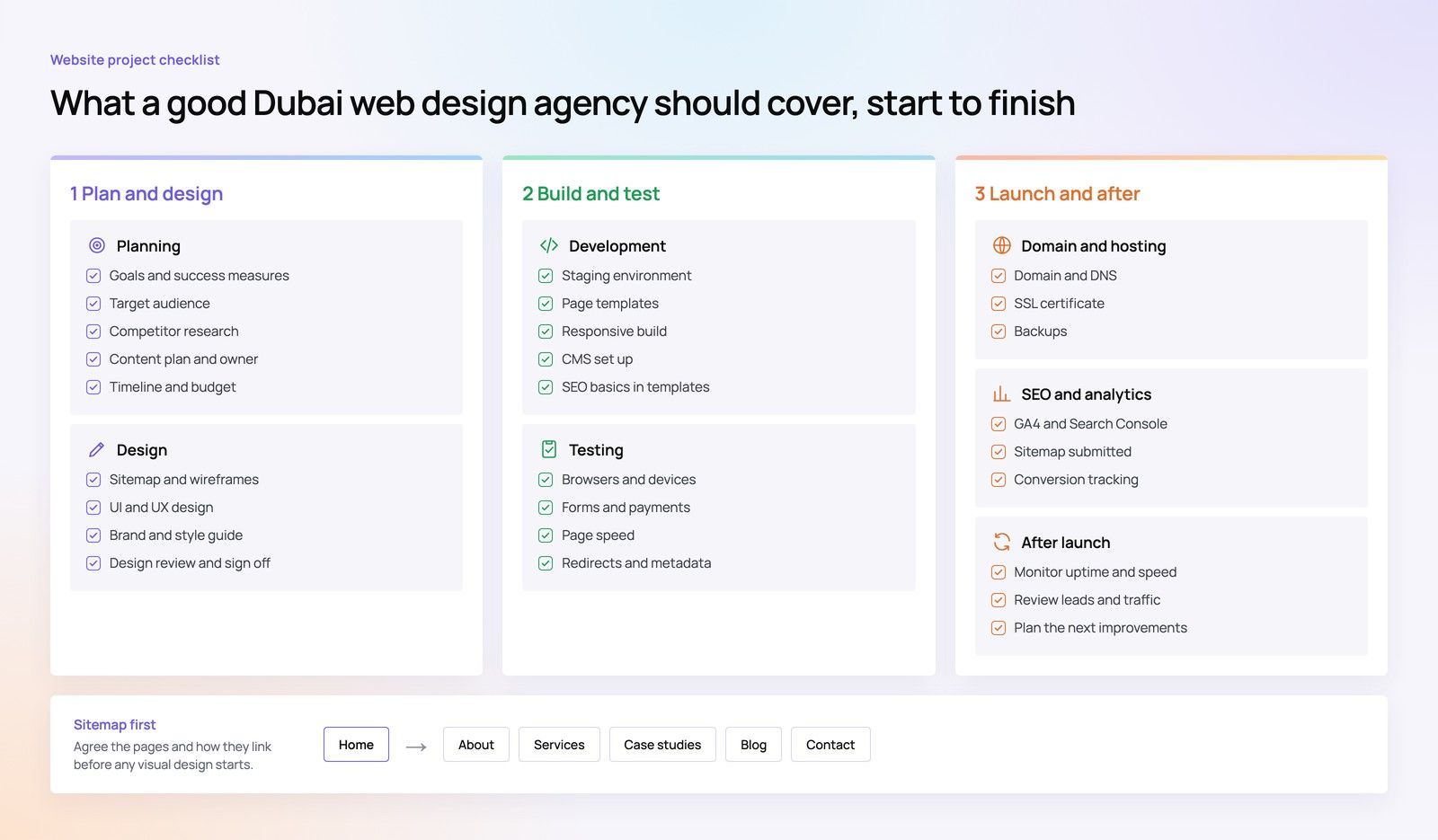
How long does it take to build a website at enterprise scale? A planning method
Rather than starting from a generic week count, build the timeline from the bottom up. The steps below produce an estimate that reflects your organisation rather than an average.
- List every stage. Discovery, information architecture, design, content, development, integrations, testing, security review, migration and launch. The stages are described in more detail in our guide to enterprise website development stages.
- Name the approvers for each stage. Write down who signs off, how many review rounds are allowed and how long each person needs.
- Map dependencies. Mark which tasks cannot start until another finishes, such as template build before content entry, or security approval before go live.
- Identify external calendars. Note change freezes, public holidays, Ramadan working hours, financial year end and planned campaigns that could limit release dates.
- Estimate effort and waiting time separately. A task may need three days of work but ten days of elapsed time once reviews are included. Track both.
- Add buffers at the right points. Place contingency before hard milestones, not spread thinly across every task.
- Agree the plan with stakeholders. A schedule that the approvers have not seen is a guess, not a commitment.
Where to place buffers
Spreading small amounts of slack across every task tends to disappear without anyone noticing. Concentrated buffers are easier to protect and easier to report on.
| Point in the plan | Why a buffer helps | What it absorbs |
|---|---|---|
| After design approval | Feedback rounds are hard to predict | Extra revisions and stakeholder disagreements |
| Before integration testing | Other teams control connected systems | Late API access and partner release schedules |
| After content freeze | Content is often the latest input | Translation, legal review and image sourcing |
| Before the security sign off | Findings can require rework | Penetration test fixes and configuration changes |
| Before the launch date | Launch is visible and hard to move | User acceptance testing defects and redirect checks |
Shortening the timeline without cutting quality
Some time can be recovered by changing how the organisation works rather than asking the build team to go faster.
Decide governance before kickoff
Appoint a single accountable sponsor with authority to settle disputes. Our article on enterprise website readiness covers the decisions worth making before the project starts, from approval rights to content ownership.
Run security and procurement in parallel with design
Share the proposed architecture with IT security during discovery, not after the build. Raise licence and hosting purchase requests as soon as the technology choices are confirmed.
Start content early and in waves
Prioritise the templates and pages that matter most at launch. A first wave of key pages can move through review while secondary content is still being written. Retiring outdated pages during an audit before the rebuild also reduces the volume that needs writing and approval.
Phase the launch
Not every feature needs to be live on the first day. A phased release, where core pages launch first and lower priority features follow, can reduce pressure on the launch date. It works best when the phases are agreed in the scope rather than improvised when the plan slips.
Keep the review rules simple
Consolidated feedback from one person per business unit is faster than comments from everyone. Set a fixed review window, and treat silence at the end of it as approval unless the governance rules say otherwise.
Warning signs that the timeline is at risk
Most overruns are visible weeks before the launch date moves. Watch for these signals in status reports:
- Approvals marked "in progress" for longer than the agreed review window.
- Integration environments still not available when development needs them.
- Content trackers showing large numbers of pages without an owner.
- Security review not yet scheduled once templates are being built.
- Scope requests arriving without going through change control.
- Stakeholders seeing the site for the first time during user acceptance testing.
Any one of these is manageable on its own. Several together usually mean the launch date needs an honest conversation. The patterns behind late failures are covered in more depth in why enterprise redesigns fail before launch.
Hypothetical example: two similar sites, two different schedules
Hypothetical example: two Dubai organisations each plan a site with a similar number of templates and a CRM connection. The first has one sponsor who can approve design, content and launch decisions, uses an existing hosting setup already approved by IT, and has content ready in both English and Arabic before development starts. The second needs approval from four departments, must procure new hosting, and plans to write content once the templates are built.
The development effort is broadly the same. The second project still takes considerably longer, because each approval, purchase and review adds elapsed time that the build team cannot compress. Planning that difference at the start lets the second organisation set a realistic date and protect it, rather than discovering the gap halfway through.
Planning your enterprise build with Codeeo
Codeeo designs and builds enterprise websites through its website design and development service, with UI/UX design and integrations with business systems such as CRM and ERP. With 200+ projects delivered across the UAE and the US and an office in Dubai, UAE clients can meet the team in person to work through stages, approvers and dependencies before a schedule is agreed. If you would like a realistic plan for your project, contact the Codeeo team to talk through your requirements.
Frequently asked questions
It is safer to commit to a target window and confirm the exact date after discovery.
Discovery often reveals integrations, content volume or compliance needs that were not visible during procurement. A date fixed earlier is usually based on assumptions that have not been tested. If a business event forces a fixed date, reduce scope or phase the launch so the date stays achievable.
Digital TransformationReplatforming From Drupal, AEM or .NET Without DowntimeWebsite replatforming from Drupal, AEM or .NET without downtime: choose the target platform, run delta content syncs, plan the cutover and test your rollback. Digital TransformationWhat a Good Enterprise Website SLA ContainsWhat a website maintenance SLA should contain, clause by clause: scope, severity tiers, response and resolution times, uptime, reporting, remedies and exit.
 Digital TransformationTreating Your Website as a Production System: The Case for an SLAWhy a business critical website needs an SLA: hypothetical incident costs, what changes with agreed response times, and how to make the case for support.
Tell us what the business needs. We will tell you what to build first.
Schedule a free consultation and get a written recommendation, with costs, before you commit to anything.
Get in touchPROVEN RESULTS
4.7 / 5verified reviews on Google