 Web DevelopmentWordPress VIP or Self Hosted Enterprise WordPress in the UAEWordPress VIP or self hosted enterprise WordPress in the UAE: compare data residency, hosting SLA, cost drivers and code review rules, plus key setup notes.
What a WordPress Maintenance SLA Should Cover
What WordPress maintenance services should cover in writing: core and plugin updates, security, backups, multilingual publishing support and response times.
Good WordPress maintenance services are defined by a written service level agreement, not by a vague promise to "keep the site updated". The SLA should state exactly how core, plugin and theme updates are handled, how security incidents and outages are prioritised, what content and multilingual publishing support is included, and how quickly each type of request is answered. If a point is not in writing, assume it is not covered.
This guide focuses on what is specific to WordPress. It is a checklist to hold against any proposal you receive, whether from an agency, a freelancer or an internal team.
Why WordPress maintenance services need their own SLA
A generic website support contract tends to talk about hosting uptime and "minor changes". WordPress sites have particular moving parts that a generic contract misses:
- Frequent third party updates. Core, plugins and themes each release updates on their own schedules, and some of them change the database.
- Plugin interactions. An update to one plugin can break another, or break the theme.
- A large attack surface. Because WordPress is so widely used, outdated plugins and weak admin accounts are routinely targeted.
- Editors working daily. Marketing teams publish and edit constantly, often in more than one language, and need help when something will not behave.
A WordPress SLA should address each of these by name.
Core, plugin and theme updates
WordPress updates are the heart of any WordPress support plan, and the area where contracts are most often vague.
What the SLA should say
- Frequency. How often routine updates are applied, for example in a scheduled weekly or monthly window.
- Process. Whether updates are tested on a staging site first, and which checks are run before and after. Our guide to WordPress release management with staging, QA and rollback describes a routine worth asking for.
- Security releases. How quickly critical security updates are applied outside the normal window.
- Automatic updates. Which components, if any, are left on automatic updates. WordPress lets administrators switch these on plugin by plugin and theme by theme, so the choice should be deliberate and recorded.
- Major versions. Whether major upgrades, such as a new PHP version on the server or a large plugin rewrite, are included or quoted separately.
- Licences. Who holds and renews premium plugin and theme licences. If the provider holds them and the contract ends, you may lose update access.
When an update breaks something
The SLA should say who fixes a fault caused by an update and whether that work is included. A provider that applies an update and then charges to repair the damage has little reason to test properly. Ask also how rollback works and how long backups are kept.
Security, backups and monitoring
Preventive security
WordPress's own hardening guidance covers the basics: keep everything updated, remove unused plugins and themes, use strong credentials and two step authentication, and disable file editing in the dashboard. The SLA should confirm which of these the provider handles and which remain your responsibility. User accounts are a common gap, so agree who reviews admin roles and removes former staff. Our article on admin roles, approvals and MFA covers this in detail.
Backups
- How often the database and files are backed up, and how many copies are kept.
- Where backups are stored, ideally away from the hosting server itself.
- How often a restore is actually tested.
- How quickly a restore will be started once you ask for one.
Monitoring and incident response
Uptime monitoring, malware scanning and error log review should be listed, along with what happens when an alert fires. A clear incident process names who is contacted, how, and in what time. If the site holds personal data, the SLA should also say how the provider will support you if a breach is suspected. UAE businesses may have obligations under the federal Personal Data Protection Law, or under the DIFC or ADGM regimes if they operate there, so confirm your notification duties with counsel and make sure the provider's process fits them.
Performance and hosting responsibilities
Many disputes come from unclear lines between the maintenance provider and the host. The SLA should say who is responsible for:
- Server software and PHP version upgrades.
- Caching and CDN configuration.
- Investigating slow pages and Core Web Vitals problems.
- Database clean up, such as removing old revisions and expired temporary data.
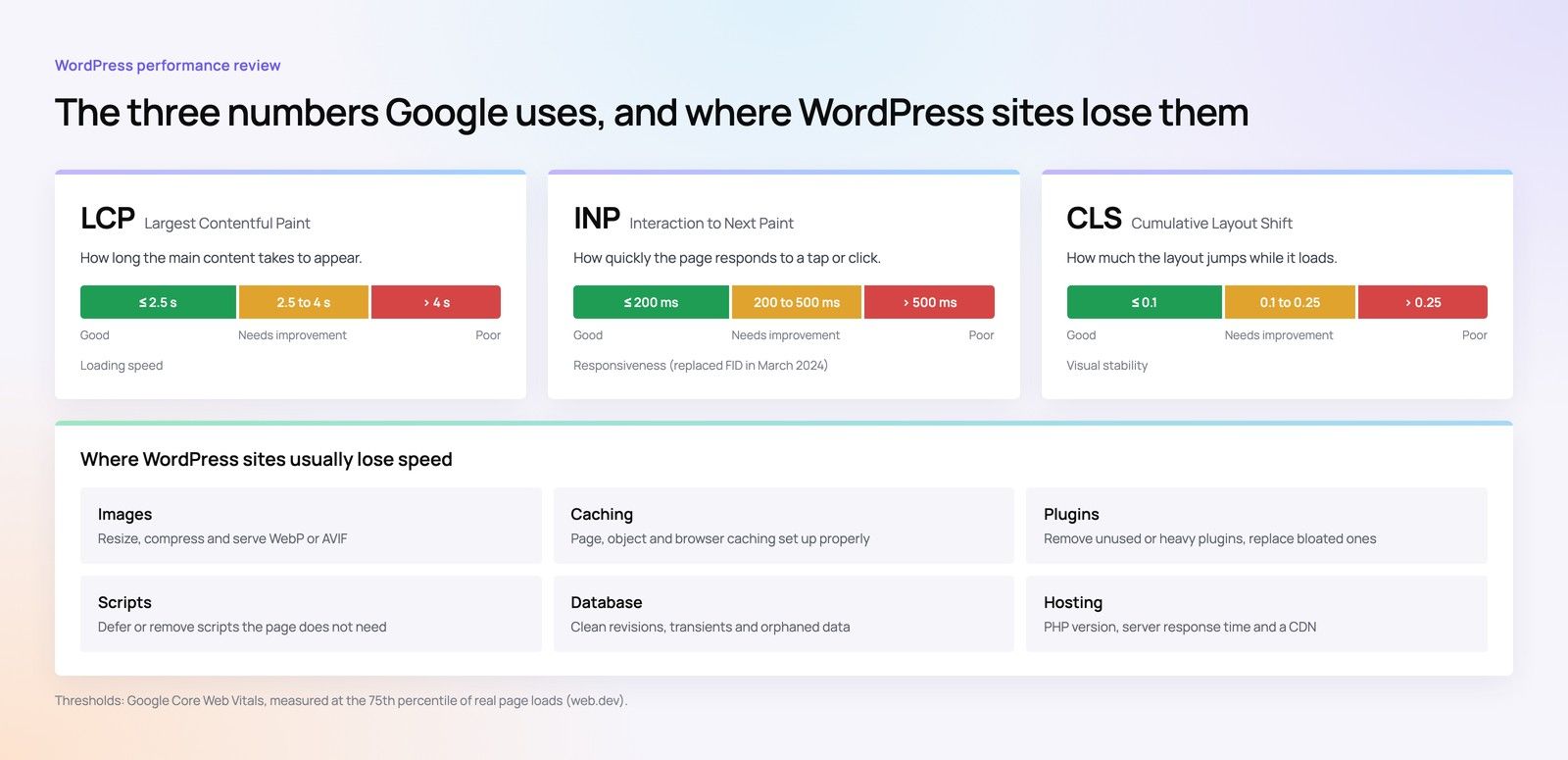
If performance is in scope, agree how it is measured and how often it is reviewed. A periodic report that compares key pages over time is more useful than a promise that the site will "stay fast".
Content and multilingual publishing support
For many UAE organisations, editorial support matters as much as technical upkeep. Sites often publish in English and Arabic, sometimes in further languages, and editors need help when layouts break or translations go missing.
Multilingual publishing support to define
- Help with the translation plugin: creating language versions, linking translations and fixing language switchers.
- Right to left layout checks for Arabic pages after theme or plugin updates.
- Translated menus, forms and email notifications.
- Whether the provider loads translated content or only supports your team to do it.
General content support
Spell out what counts as a support request and what counts as new work. Typical inclusions are publishing help, fixing broken blocks or layouts, adding redirects and uploading documents. New page templates, new features and design changes are usually separate. If the plan includes a bank of hours for small changes, check whether unused hours roll over and how they are reported.
For headless WordPress sites, content support also covers preview and publishing between the CMS and the front end. See headless WordPress preview and editorial workflow for what that involves.
Response times and priority levels in a WordPress SLA
The WordPress SLA should define priority levels by business impact, then set a response time and a target fix or workaround time for each. A typical structure looks like this:
| Priority | Example on a WordPress site | What the SLA should state |
|---|---|---|
| Critical | Site down, checkout failing, site hacked or defaced | Response time, hours of cover including weekends, who is called |
| High | A key form not sending, admin login broken, a major page erroring | Response time and target workaround time |
| Normal | Layout issue on one template, a plugin feature misbehaving | Response time and target fix within business hours |
| Low | Content help, small changes, questions | Response time and how requests are queued |
Questions to ask about response times
- Is "response" an automated acknowledgement or a person starting work?
- Which hours and which time zone do the times apply to, and are weekends and public holidays covered for critical issues?
- How are requests raised: ticket, email, phone or chat?
- What happens if the provider misses a target?
Reporting, ownership and exit terms
Reporting
A monthly or quarterly report should list updates applied, incidents and how they were resolved, backup and restore tests, and any recommendations. Without it, you cannot tell whether the work is being done.
Access and ownership
You should own the domain, hosting account, code repository and premium licences, or at least hold administrator access to all of them. The SLA should confirm the provider will hand over credentials, code and documentation at the end of the contract.
Exit and handover
Agree a notice period and what the provider delivers when leaving: a current backup, a list of plugins and versions, outstanding issues and any custom code. This protects you if you later change providers or bring support in house.
Hypothetical example: an Abu Dhabi training provider runs a bilingual WordPress site with course booking. Its SLA lists weekly staged updates, daily off server backups with a quarterly restore test, Arabic layout checks after each update, and a critical priority level for booking failures with weekend cover. When a booking form plugin update breaks Arabic field labels, the provider rolls back on the same day under the agreed process and fixes the issue on staging.
How an enterprise WordPress SLA differs
Larger organisations usually add code review standards, formal change approval, security testing, accessibility checks and named contacts. Hosting choice affects this too: on a managed enterprise platform, some responsibilities move to the host. Our comparison of WordPress VIP and self hosted enterprise WordPress explains how that changes the split. For smaller businesses comparing simpler packages, website maintenance plan tiers is a better starting point.
Talk to Codeeo about WordPress support
Codeeo's WordPress development team builds and supports WordPress sites for businesses across the UAE, including bilingual English and Arabic sites. If you are unsure what your current setup needs, a website audit gives you a clear picture before you agree any SLA, and if speed is the main concern, see our Core Web Vitals service. Teams that need ongoing development capacity can also work with dedicated developers. Codeeo is rated 4.7 from 23 Google reviews, and our Dubai office means you can meet the team in person. Contact us to discuss the support your site needs.
Frequently asked questions
It can simplify things, because one party owns every fault.
The trade off is less flexibility if you later want to move one part. If they are separate, the SLA must define the boundary clearly, especially for server upgrades, caching and outages, so that neither side can say a problem belongs to the other. Ask both parties how they will work together during an incident.
Web DevelopmentWordPress VIP or Self Hosted Enterprise WordPress in the UAEWordPress VIP or self hosted enterprise WordPress in the UAE: compare data residency, hosting SLA, cost drivers and code review rules, plus key setup notes. Web DevelopmentWordPress Release Management: Staging, QA and RollbackA WordPress deployment workflow that releases safely: Git based builds, a staging site that mirrors live, smoke tests to run and a rollback plan written first.
 Web DevelopmentOne Security Checklist for WordPress, Django and Strapi SitesWebsite security checklist for organisations running WordPress, Django and Strapi: admin access, secrets, updates, APIs, data and recovery side by side.
Tell us what the business needs. We will tell you what to build first.
Schedule a free consultation and get a written recommendation, with costs, before you commit to anything.
Get in touchPROVEN RESULTS
4.7 / 5verified reviews on Google