 Web DevelopmentWordPress VIP or Self Hosted Enterprise WordPress in the UAEWordPress VIP or self hosted enterprise WordPress in the UAE: compare data residency, hosting SLA, cost drivers and code review rules, plus key setup notes.
The Launch Page Set: Which Pages a New Business Site Needs
The pages every business website needs at launch, mapped to the questions buyers ask, plus the pages that can wait for phase two so small teams launch on time.
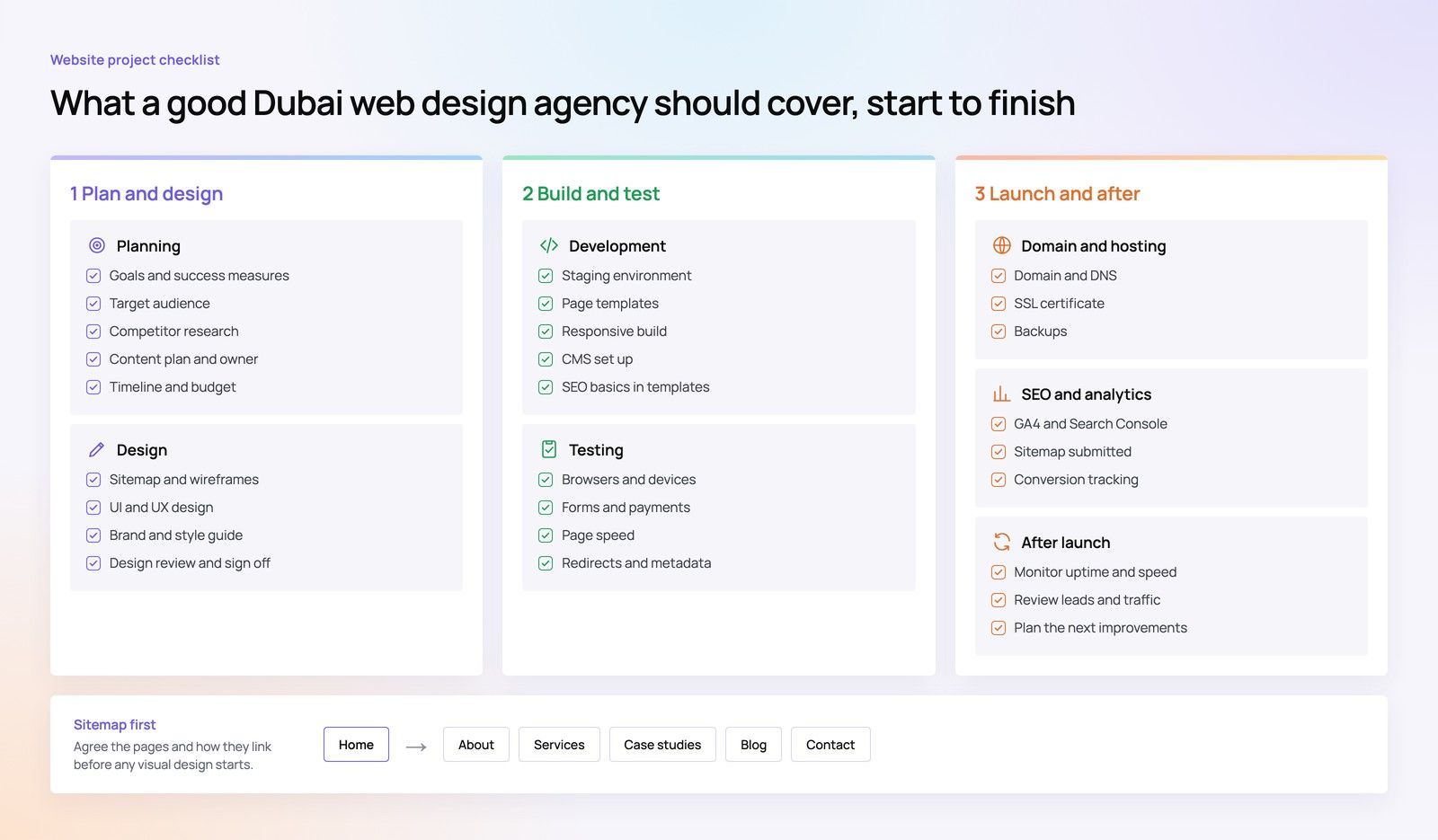
The pages every business website needs at launch are the ones that answer a buyer's first questions: what you do, whether you can be trusted, whether you serve them and how to get in touch. For most new businesses that means a homepage, one page per core service, an About page, proof, a contact page and the legal pages. Everything else can wait for phase two, and treating it that way is how small teams avoid stalling on content.
Start from buyer questions, not a sitemap template
Most stalled website projects stall on content, not design. A team copies a sitemap from a competitor, ends up with 25 pages to write and launches months later than planned. A better method is to list the questions buyers ask before they enquire, then give each question a home.
| Buyer question | Page that answers it |
|---|---|
| What do you do, and is it for a business like ours? | Homepage |
| Can you solve our specific problem? | Service or product pages |
| Who are you, and are you legitimate? | About page |
| Have you done this before? | Case study or work page |
| How do we reach you, and where are you? | Contact page |
| What happens to our data and our order? | Privacy policy and terms |
If a planned page does not answer a real buyer question, it probably belongs in phase two or nowhere.
The launch set: pages every business website needs
These essential website pages form a complete small business sitemap. Each section below covers what the page must do and what to put on it.
1. Homepage
The homepage is a routing page. Its job is to confirm a visitor is in the right place and send them to the right next page within seconds.
- A headline that says what you do and who for, in plain words.
- A short line on where you operate, for example Dubai, the Northern Emirates or the whole UAE.
- Links to each core service, with one sentence on each.
- A small amount of proof: a review, a project image or a key credential you can genuinely show.
- One primary call to action, such as "Request a quote" or "Book a visit".
2. Service pages
Good service page structure is the single biggest factor in whether a small site generates enquiries. Give each core service its own page rather than listing everything on one "Services" page. Separate pages can match what people search for, and they let you speak to each buyer's specific concern.
A practical structure for each service page:
- What the service is and the problem it solves, in two or three sentences.
- Who it is for, and who it is not for.
- What is included, as a short list.
- How the process works, step by step.
- Proof related to this service specifically.
- Questions buyers commonly ask about it.
- A clear call to action and contact options.
Three to six service pages is a realistic launch number for most small firms. If you offer twenty services, group them into the few that drive most revenue and add the rest later.
3. About us page
The about us page answers a quieter question: are these people real and reliable? Google's guidance on helpful content also encourages sites to make it clear who is behind them, and an About page is the natural place to do that.
- Who founded or runs the business, with real photos where possible.
- When and why the company started, briefly.
- The team or key people, with their roles.
- Your trade name, location and the emirates you serve.
- What you believe about how the work should be done, in a few sentences, not a mission statement.
4. Case study page
A case study page shows that you have solved similar problems before. New businesses often skip it because they have little to show. Start with what you have: two or three honest examples, each with the situation, what you did and what the client received. Use only real work, and get permission before naming a client. If you have no client work yet, show your process, sample deliverables or qualifications instead, and add case studies as projects finish.
5. Contact page
The contact page is where a decision becomes an enquiry, so remove every obstacle.
- Phone number, WhatsApp link and email, all clickable on mobile.
- Address and an embedded map, or service areas if you do not receive visitors.
- Opening hours, including Friday and weekend hours if they differ.
- A short form that asks only what you need to reply.
- What happens next, for example "We reply within one working day", only if you can keep that promise.
Keep the business name, address and phone number identical to your Google Business Profile. Google asks that the profile reflect how the business appears in the real world, and consistent details make it easier for both people and search engines to connect the two.
6. Privacy policy and terms
If your site has a contact form, analytics or a newsletter sign up, it collects personal data. The UAE Personal Data Protection Law (Federal Decree Law No. 45 of 2021) applies to electronic processing of personal data, and businesses in the DIFC or ADGM have their own data protection regimes. A privacy policy explains what you collect and why. If you sell online, add terms covering delivery, returns and payment. Ask a legal adviser to confirm what applies to your licence and activity rather than copying another company's text.
What can safely wait for phase two
Phase two pages are valuable, but none of them should block launch. Add them once the core pages are live and you can see which questions and services bring enquiries.
| Page | Why it can wait | When to add it |
|---|---|---|
| Blog or insights | Needs a steady publishing rhythm to be useful | When someone can commit to regular articles |
| Separate FAQ page | Questions fit better on service pages at first | When the same questions span many services |
| Careers | Job posts can live on recruitment platforms | When hiring becomes regular |
| Location pages per emirate | Thin pages without real local detail add little | When you have staff, projects or offices to show in each area |
| Industry pages | Need specific proof per sector | When you have case studies in that sector |
| Arabic version | Depends on your audience | Plan for it now if Arabic speaking buyers are core; add later otherwise |
| Landing pages for ads | Only needed once campaigns run | Before the first paid campaign launches |
Two of these deserve a caution. If Arabic speakers are a core audience, plan the bilingual structure before design starts, because retrofitting right to left layouts is harder than building them in. Our guide to planning a bilingual Arabic English site covers the decisions to make early. And if you plan to run ads soon after launch, read landing pages for paid traffic before the campaign starts, because sending ad clicks to a homepage usually wastes budget.
A realistic content plan for a small team
The launch set is roughly eight to twelve pages. That is manageable if content work starts at the same time as design, not after it.
- Week by week ownership. Assign each page to one person, with a draft date.
- Write service pages first. They take longest and matter most for enquiries.
- Collect proof early. Photos, reviews and client permissions take time to gather.
- Use real content in design reviews. Placeholder text hides layout problems until the end.
- Set a cut line. Anything not ready by the agreed date moves to phase two rather than delaying launch.
Hypothetical example: a new interior fit out company in Dubai plans fifteen pages, including separate pages for every emirate and a blog. Applying the launch set reduces it to a homepage, four service pages, About, a work page with three projects, Contact, privacy and terms. The emirate pages and blog move to phase two, and the site launches with everything a buyer needs to make contact.
Choosing the right build for your launch set
The number and type of pages affects how the site should be built. A small brochure site with rarely changing content can be simple, while a site that will grow into many service, location and blog pages needs a content management system your team can use. Our comparison of static and dynamic websites explains the trade off. If you are replacing an older site that keeps breaking as you add pages, the signs a site has outgrown templates will help you decide whether custom work is justified.
Plan your launch pages with Codeeo
Codeeo helps UAE businesses plan, design and build websites that launch with the pages buyers need and grow cleanly afterwards. Our website development and UI/UX design teams can map your services into a page structure, and our WordPress development team can set up a content system your staff can manage. With 200+ projects delivered across the UAE and the US and an office in Dubai, you can work through the plan with us face to face.
Get in touch to map out your launch page set.
Frequently asked questions
It depends on how you sell.
Fixed, simple offers often benefit from published pricing because it filters out poor fit enquiries. For project based work, explaining what affects cost and how quotes are prepared is usually more useful than a number that may mislead. Either way, a service page should tell buyers how to get an accurate figure quickly.
Web DevelopmentWordPress VIP or Self Hosted Enterprise WordPress in the UAEWordPress VIP or self hosted enterprise WordPress in the UAE: compare data residency, hosting SLA, cost drivers and code review rules, plus key setup notes. Web DevelopmentWhat a WordPress Maintenance SLA Should CoverWhat WordPress maintenance services should cover in writing: core and plugin updates, security, backups, multilingual publishing support and response times.
 Web DevelopmentWordPress Release Management: Staging, QA and RollbackA WordPress deployment workflow that releases safely: Git based builds, a staging site that mirrors live, smoke tests to run and a rollback plan written first.
Tell us what the business needs. We will tell you what to build first.
Schedule a free consultation and get a written recommendation, with costs, before you commit to anything.
Get in touchPROVEN RESULTS
4.7 / 5verified reviews on Google