 Web DevelopmentWordPress VIP or Self Hosted Enterprise WordPress in the UAEWordPress VIP or self hosted enterprise WordPress in the UAE: compare data residency, hosting SLA, cost drivers and code review rules, plus key setup notes.
Questions to Ask a Dubai Web Design Agency Before You Sign
Questions to ask a web design agency before you sign, with strong and weak answers, red flags to watch for and a scoring sheet for your final Dubai meeting.

The most useful questions to ask a web design agency are the ones that force specific answers about people, process, ownership and support after launch. A confident agency answers them with names, examples and documents; a weak one answers with adjectives. Use the script below in your final meeting, listen for the difference, and score each answer before you sign.
This guide assumes you have already narrowed the field. If you are still comparing ten names, start with our method for shortlisting web design companies in the UAE, then come back here with your final two or three. Whether each finalist is a web design agency in Dubai, Abu Dhabi or overseas, the questions stay the same.
Preparing your questions to ask a web design agency
A vendor interview works best when it feels like a working session rather than a sales pitch. A little preparation changes the quality of what you hear.
Who should be in the room
On your side, bring the person who will own the website day to day and someone who signs off budget. On the agency side, ask for the project lead or designer who would actually work on your account, not only the account manager. If the agency cannot tell you who that will be, note it.
Send three things in advance
- A one page summary of what the site must do: generate enquiries, sell products, support recruitment, or explain a complex service.
- Your current site address and any analytics access you are willing to share.
- A list of systems the site must connect to, such as a CRM, booking tool, payment gateway or ERP.
Agencies that read this material will ask sharper questions. Agencies that ignore it will repeat their standard deck, which tells you something too.
Questions about relevant experience
1. Show us two projects closest to ours and explain what you would do differently now
This one question tests relevance and honesty together. You want work with a similar buyer type, content volume or integration need, not simply attractive screenshots.
Strong answer: "This B2B services site had a similar enquiry flow. We would now split the contact form by service so the sales team can route leads faster."
Weak answer: "All our sites are award quality. We can do anything you need."
2. Can we speak to a client whose project had problems?
Every agency has a happy reference. The useful conversation is with a client whose project slipped or changed scope, because it shows how the agency behaves under pressure. An agency that offers this willingly is usually comfortable with its own process.
3. Who exactly will work on our project, and where are they based?
Ask for roles and, where possible, names: project manager, designer, developer, content or SEO lead. Ask which of them you can meet in person if you are in Dubai or Abu Dhabi, and which work remotely. A blended team is common and can work well; what matters is that you know who is responsible.
Questions about process and the web design proposal
4. Walk us through your process from kickoff to launch
Listen for discovery, content planning, wireframes, design, build, testing and launch as distinct stages with clear sign off points. Ask where your team needs to give input and how much time that takes.
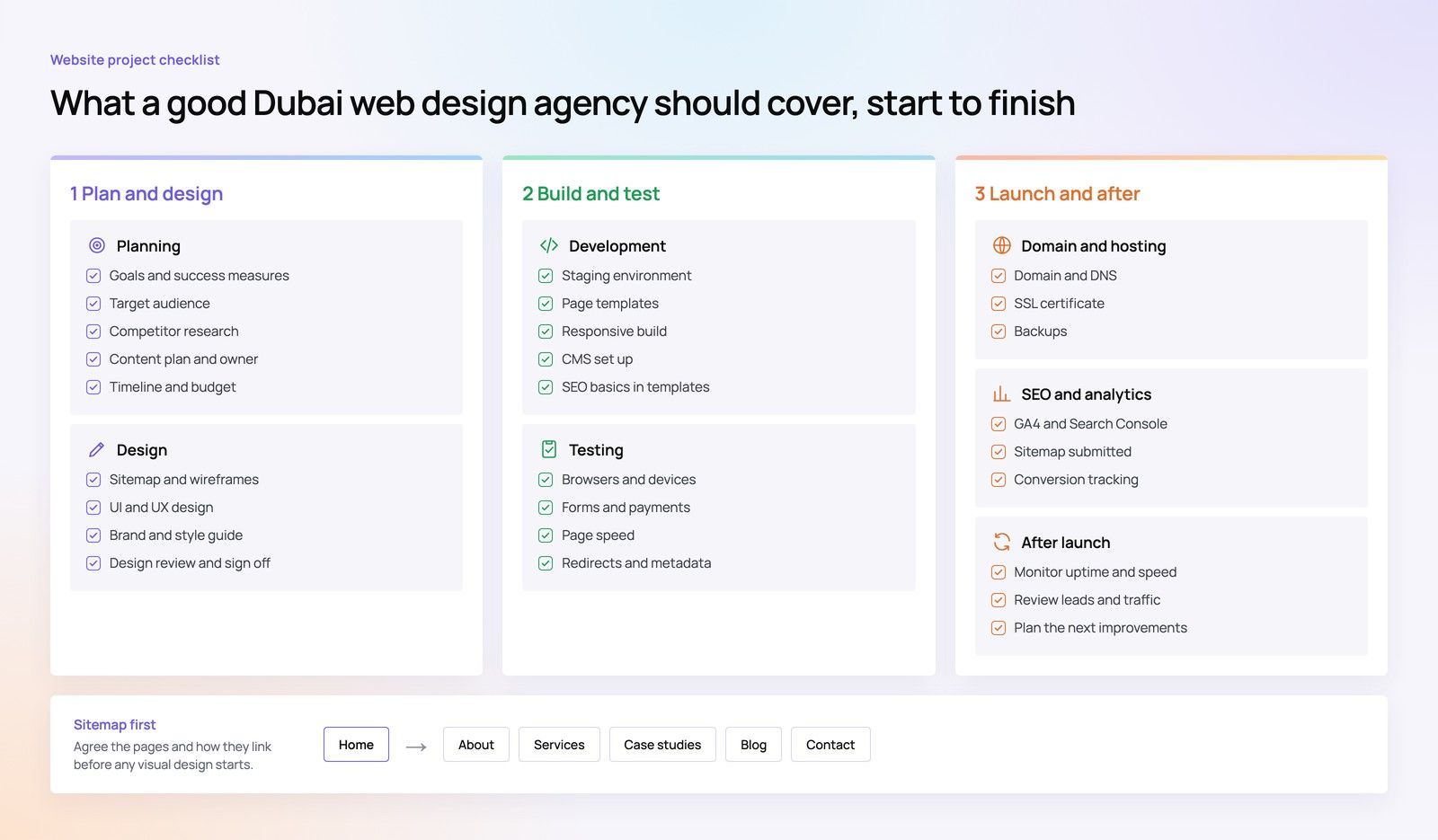
5. What is included in the web design proposal, and what is not?
A good web design proposal lists deliverables in plain terms: number of page templates, content entry, integrations, browsers and devices tested, training, and post launch support. Ask the agency to name three things clients often assume are included but are not. Common examples are copywriting, photography, Arabic translation, data migration from an old site and ongoing SEO.
Strong answer: "Copy is not included. We provide a content template per page and one round of editing on your drafts."
Weak answer: "Everything you need is covered."
6. How do you handle changes after design sign off?
Changes are normal. What you need is a written change process: how requests are logged, estimated and approved before work starts. Without it, small additions become disputes at invoice time.
7. How many design rounds are included, and what counts as a round?
Ask for a definition. Some agencies count every email of feedback as a round; others count a consolidated set of comments. Agree that your team will collect feedback into one document per round so the count is fair to both sides.
Questions about technology and ownership
8. Which platform do you recommend for us, and why not the alternatives?
A thoughtful agency explains its choice against your needs: who edits content, how often, what integrations matter and how the site might grow. Be cautious if every client gets the same platform regardless of brief. Ask them to explain one situation where they would not recommend their preferred option.
9. Who owns the domain, hosting account, code and design files?
The answer should be simple: you do. Domains and hosting should be registered in your company's name or an account you control, with the agency given access. Ask for design source files and code repository access to be part of the handover.
Strong answer: "You hold the domain and hosting accounts. We work through a user we create on your account and hand over the repository at launch."
Weak answer: "We host everything for you, so you never need to worry about it."
10. How will the site handle personal data from our forms?
If the site collects names, phone numbers or other personal data, ask where form submissions are stored, who can access them and how consent is captured. The UAE has a federal Personal Data Protection Law (Federal Decree-Law No. 45 of 2021), and companies in the DIFC or ADGM have their own data protection regimes. An agency is not your legal adviser, but it should understand the basics and suggest you confirm specifics with counsel.
11. How do you approach speed, accessibility and search basics?
Ask how they test page speed on mobile, whether they design to the Web Content Accessibility Guidelines (WCAG) from the W3C, and how they handle redirects if you are replacing an existing site. Losing old URLs without redirects is one of the most common causes of lost search traffic after a redesign.
Questions about life after launch
12. What does support look like in the first three months?
Ask how bugs are reported, how quickly they are acknowledged, and whether support is covered by the project fee or a separate agreement. Get the answer in writing.
13. Can our team update the site without you?
Request a short demo of the editing experience on a live client site. If adding a new page or swapping a banner requires a developer, ongoing costs will rise and your marketing team will slow down.
14. If we part ways, what do we receive?
This is not pessimism. A clear exit answer, covering files, credentials, documentation and a handover call, shows an agency that expects to keep clients through good work rather than lock in.
Agency red flags to note during the meeting
Some agency red flags appear in what is said, others in what is avoided. Watch for these:
- No named project lead, or a different person at every meeting.
- A fixed launch date promised before they have seen your content or integrations.
- Reluctance to put ownership of domain, hosting and code in writing.
- Portfolio items that cannot be found live, or live sites that look very different from the screenshots.
- Pressure to sign quickly because of a time limited discount.
- Vague answers on what happens after launch.
- Claims of guaranteed rankings or guaranteed sales results.
Score the answers before you decide
Agency interview questions only help if you compare answers on the same basis. Score each agency from 1 to 5 on the criteria below straight after the meeting, while the conversation is fresh.
| Criterion | What a high score looks like |
|---|---|
| Relevance | Similar projects shown, with lessons learned |
| Team clarity | Named roles, a meeting with the actual project lead |
| Scope clarity | Inclusions and exclusions listed in the proposal |
| Ownership | Domain, hosting, code and files confirmed as yours |
| Change control | Written process for changes and design rounds |
| Support | Defined support period and response process |
| Fit with your team | They asked good questions about your business |
Hypothetical example: a Dubai trading company compares two agencies. Agency A has the more polished portfolio but scores low on ownership and support. Agency B shows fewer projects but answers every ownership question clearly and introduces its developer in the meeting. The scoring makes the trade off visible, and the company asks Agency A to revise its terms before deciding.
Visual style matters too, but it is easier to fix than a weak process. Our guide to web design trends worth adopting in the UAE can help you judge design proposals separately from delivery. If you are hiring an SEO partner as well, the same discipline applies; see vetting an enterprise SEO agency before signing.
Bring these questions to Codeeo
Codeeo designs and builds websites for UAE businesses from its office in Dubai, with a team of 80+ across Dubai, Riyadh and Karachi and 200+ projects delivered across the UAE and the US. You are welcome to put every question in this guide to us, meet the people who would work on your project, and review relevant work in our case studies.
Explore our UI/UX and web design and web development services, or read what professional web design actually changes for a UAE business. When you are ready, contact the team to arrange a meeting.
Frequently asked questions
Two or three in the final stage is usually enough.
More than that tends to blur the comparison, and good agencies may hesitate to invest time in a long pitch process. Do the broad filtering earlier using portfolios, references and team location, then spend real time with a small number so each meeting can go into the depth these questions need.
Web DevelopmentWordPress VIP or Self Hosted Enterprise WordPress in the UAEWordPress VIP or self hosted enterprise WordPress in the UAE: compare data residency, hosting SLA, cost drivers and code review rules, plus key setup notes. Web DevelopmentWhat a WordPress Maintenance SLA Should CoverWhat WordPress maintenance services should cover in writing: core and plugin updates, security, backups, multilingual publishing support and response times.
 Web DevelopmentWordPress Release Management: Staging, QA and RollbackA WordPress deployment workflow that releases safely: Git based builds, a staging site that mirrors live, smoke tests to run and a rollback plan written first.
Tell us what the business needs. We will tell you what to build first.
Schedule a free consultation and get a written recommendation, with costs, before you commit to anything.
Get in touchPROVEN RESULTS
4.7 / 5verified reviews on Google